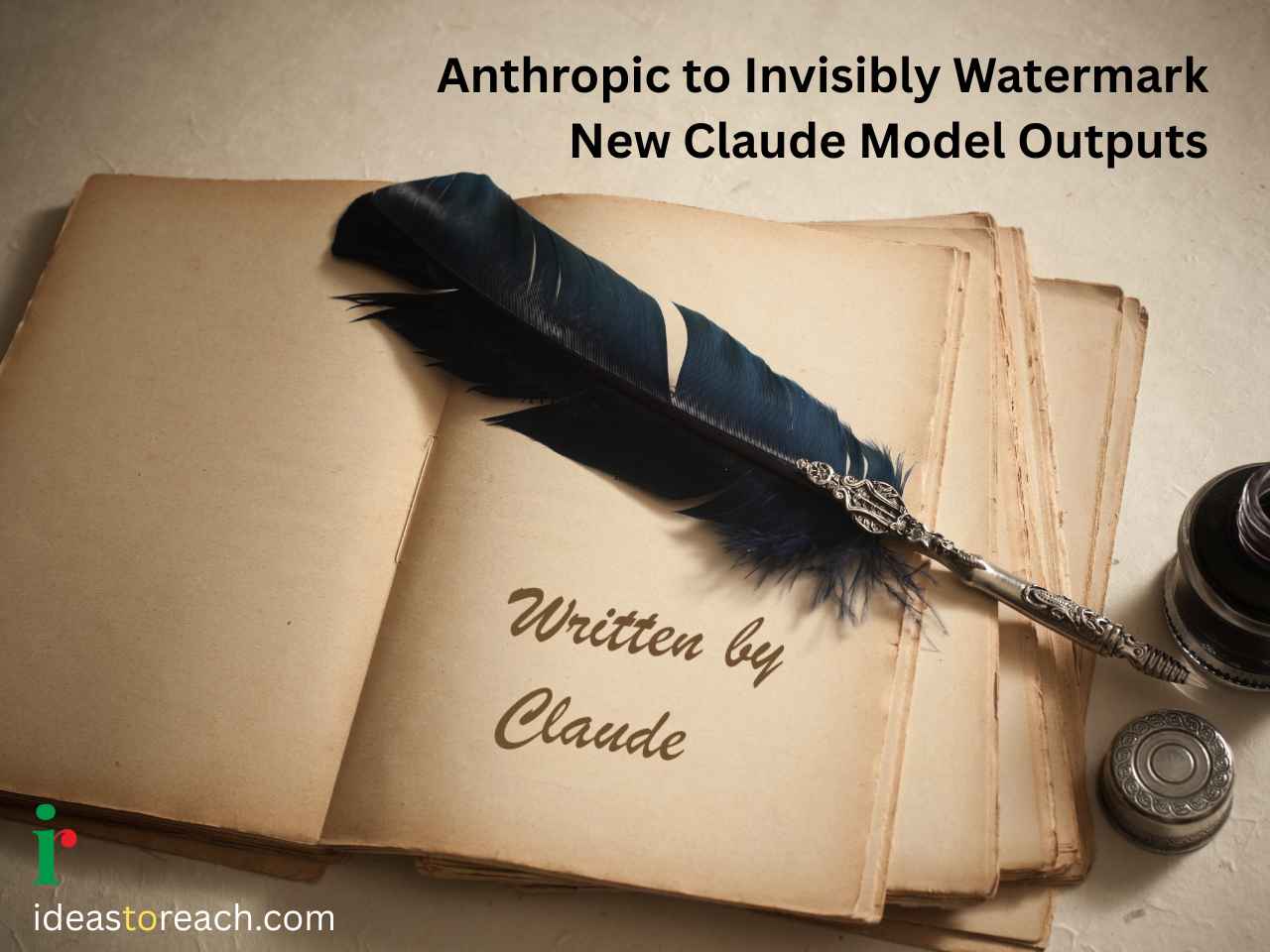
Anthropic recently announced that Claude will start embedding invisible watermarks in the text it generates, and will attach signed metadata to files like images, as part of its commitment to the EU AI Act's transparency code. Google, OpenAI, Meta, and Mistral have made similar commitments. On paper, this sounds like a serious shift. In practice, for anyone who actually writes content for a living, it changes almost nothing, and it is worth
understanding why.
The watermark is not a tag or a hidden note stuck to the end of a document. It is built into the writing process itself. As the model generates text, it is choosing between several equally good words at each step. The watermarking system quietly steers those choices to follow a pattern that only the company's own detection system can read. The result looks completely normal. Nothing changes in tone, meaning, or quality. It is a statistical fingerprint spread across the whole piece of writing, not a
visible mark.
Image files work differently. Generated images carry signed metadata following the C2PA standard, which records how the file was created. That is closer to an actual digital signature.
Here is where the idea runs into trouble. Very few serious content creators use one AI tool from start to finish. A typical workflow looks like this: pull a starting point from Perplexity or an AI Overview, structure and expand it in Claude, run it past ChatGPT for a second opinion, then refine it in Gemini for search visibility. Every one of those steps is a rewrite, and every rewrite chips away at whatever watermark the previous tool left behind. Even the researchers studying this admit that heavy paraphrasing can strip a watermark out, though not always predictably.
So a mark meant to say "AI made this" ends up detecting, at best, that AI was involved somewhere in a four-tool relay. It cannot say which tool, how much, or whether the final published piece even resembles the first draft. Four different companies each fingerprinting their own step of the same document is not a transparency system. It is several separate systems colliding inside the same paragraph.
There is a useful comparison here to health warnings on cigarette packets and liquor bottles. It is illegal to sell either product without a warning. It is completely legal to sell them with one. The warning does not touch the actual substance, it just moves the responsibility from the maker to the buyer. Once you have been told, whatever happens next is framed as your choice.
AI watermarking works on a similar logic. It does not stop AI-written content from being published, ranked, or read. It just ensures a label exists somewhere, so no one can later claim they were not informed. The underlying question, whether the content itself is any good, is left completely untouched
by the label.
But the comparison only goes so far. A cigarette stays a cigarette after half of it is smoked. A paragraph stops being any one company's paragraph after two or three genuine rewrites. Physical products keep their identity. Text does not. That is the flaw baked into this entire approach before it even reaches a detection tool.
This is where a lot of anxious speculation misses the mark. Google has been consistent on this for years, and its own guidance says the focus is on the value delivered to the reader, not how it was produced. Using AI to write is not against search policies. What gets penalised is scaled abuse: churning out textual garbage or content that is thinner than onion skin in terms of merit purely to manipulate rankings, whether a human or a machine typed it. A well-researched, fact-checked, genuinely useful post written with AI assistance is treated the same as one written entirely by hand. A thin, generic, unedited page is penalised either way.
In other words, the watermarking race between AI labs is trying to solve a problem that search ranking systems were never built to care about in the first place. It is worth noting that this same instinct, believing you can step outside a system you did not build and still come out fine, shows up elsewhere too. We looked at it from the other direction in an earlier piece on whether Reddit can survive outside Google's support. One is a platform trying to assert independence from Google. The other is a company trying to assert ownership over a language. Both are testing how much control they actually have over something much bigger
than themselves.
There is an older, more interesting question sitting underneath all of this. English is twenty-six letters, open to anyone willing to use them. Shakespeare coined phrases and rhythms that became so woven into the language that nobody today owes him a citation for using them. Style, once it is released into a language, stops belonging to the person who first used it. It becomes the language.
Think of it the way climbers think of Everest. Someone scales it by a particular route, and that route earns a name, a story, a place in the record books. But nobody plants a flag on every foothold along the way and claims the mountain itself. Others climbed before, using different lines up the same face, and thousands more will climb after, often retracing the very same steps. You can say you passed through. You cannot say the path belongs to you, because the path was there before you and will outlast you. A language works the same way. Every writer takes a known route through grammar, idiom, and rhythm that others built and others will keep walking. Claiming a permanent, traceable mark on that path is the flag-on-every-foothold move, applied to sentences instead of snow.
What AI companies are attempting is closer to that flag-planting instinct: trying to claim a permanent thread back to themselves inside a medium that has always worked by losing its origin the moment someone else reads it and makes it their own. No individual writer has ever been allowed to trademark a way of writing, and nobody thought they should be. The fact that a company can attempt something like it, because the mechanism sits inside the tool itself rather than the sentence, is a new kind of leverage, not a natural right. Every fingerprint is different because nature does not need to try. A brand, on the other hand, has to keep insisting.
Ask an AI tool to write a claim it cannot verify, for instance that a certain business is "the best in the city," and it will usually refuse and ask for sources. That caution looks admirable in the moment. But when the same tool makes a factual mistake of its own, the response is typically a flat acknowledgment and nothing more—no traceable record of error, no consequence, and no built-in accountability carrying forward. Traceability and accountability are strictly demanded of the user, yet entirely waived for the machine.
None of this changes how content should actually be created. Good writing was never about which tool typed the first draft. It was, and still is, about whether the final piece is accurate, useful, and shaped by someone who understands the subject. A watermark, visible or not, does not answer that question, and it never claimed to. Use whatever combination of tools gets you to a better piece of writing, edit it properly, and let the work stand on its own value. That was always the actual test, long before anyone started talking about invisible ink.



Please send a WhatsApp message only. Kindly do not call :
+ 91 - 99 4040 1010 | + 91 - 94 97 40 1010
Email: [email protected]