Written by : Viswanathan Ganesan 
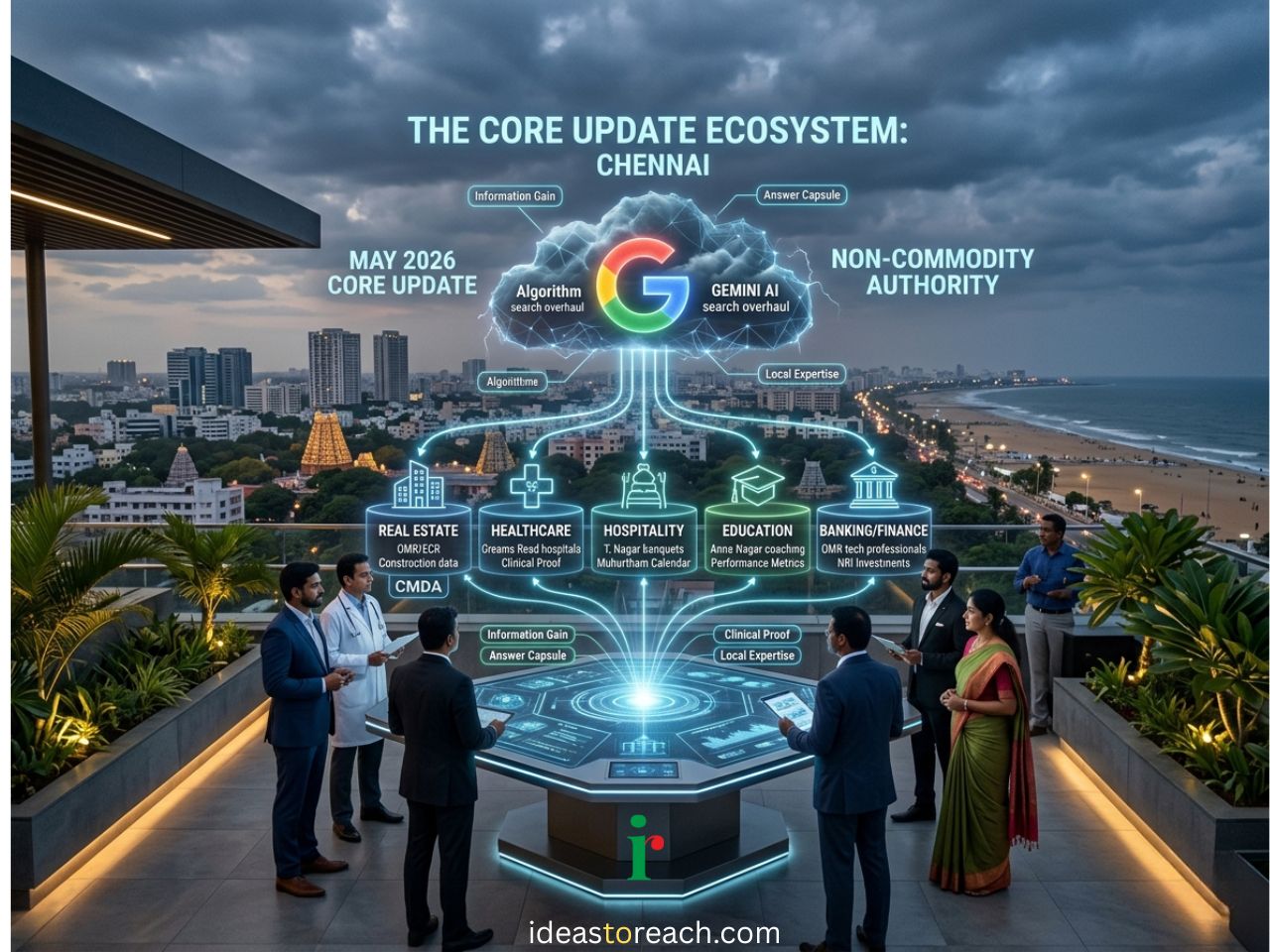
On May 21, 2026, Google initiated the rollout of its second major Core Algorithm Update of the year, as formally tracked on the Google Search Status Dashboard. Historically, a core algorithm change causes temporary visibility shifts. However, this specific update drops directly into a fundamentally altered search ecosystem: Google has simultaneously deployed its global Gemini 3.5 Flash "AI Mode" across its redesigned, intelligent search box, which now processes conversational search for over a billion monthly users worldwide.
For enterprise and mid-market brands across Chennai—where search landscape competition across Anna Nagar, OMR, and Nungambakkam is exceptionally fierce—this intersection represents an operational turning point.
Google is aggressively devaluing "commodity content"—the generic, mass-produced, or AI-synthesized text that many legacy agencies have used to inflate a domain's organic footprint. If your brand relies on search visibility to capture inquiries, direct bookings, or institutional leads in Tamil Nadu, the standard practice of tracking loose keywords must be replaced by a corporate investment in Advanced SEO Solutions in Chennai.
Below is an objective look at how this update impacts Chennai’s primary business sectors and how leadership teams must adjust their search architecture to sustain market share.
Commodity content represents any information that can be scraped, synthesized, and replicated by a large language model in less than thirty seconds. For years, digital marketing teams have built standard 800-word blogs that merely summarize pre-existing web consensus (e.g., "Basic Tips to Improve Productivity").
With the May 2026 update, Google's core quality models are actively stripping ranking weights from these redundant pages. To fix commodity content, a domain must demonstrate Information Gain—a concept rooted in providing unique, non-replicated data points, first-person case studies, or specialized regional expertise that do not exist anywhere else on the index.
From high-value residential developments in Boat Club and Poes Garden to scalable layouts along East Coast Road (ECR) and Old Mahabalipuram Road (OMR), Chennai's real estate sector operates on long-tail intent and persistent trust.
Generic articles titled "5 Reasons to Invest in Property in Chennai" are losing visibility rapidly. Because Google’s conversational AI can synthesize these baseline summaries instantly within the search interface, users have no functional reason to click through to a standard corporate site.
To survive this shift, real estate brands must transition their content asset strategy away from superficial keyword targeting and toward primary regional data that a machine cannot simulate.
The Execution: Publish dedicated, hyper-local infrastructure updates: "The OMR vs. GST Road Commercial Development Index: Metro Phase 2 Progress, Micro-Market Groundwater Assessments, and Actual Transacted Price Realities." Integrate real-time construction imagery, municipal zoning data linked directly to official CMDA (Chennai Metropolitan Development Authority) guidelines, and verifiable transit timelines. This introduces high Information Gain, making your domain the preferred reference model for both human buyers and AI engine citations.
As the recognized healthcare capital of South Indian states, Chennai’s medical institutions—from the central hubs around Greams Road to expanding facilities in Velachery and Tambaram—face severe scrutiny under Google’s Your Money Your Life (YMYL) framework.
Educational medical content that simply paraphrases baseline definitions (e.g., "What is a laparoscopic procedure?") is being heavily filtered out. Google minimizes search visibility for healthcare domains that replicate textbook medical literature without explicit institutional authority or clear clinical attribution.
Optimization in the post-May 2026 landscape requires moving from generic information to documented clinical experience and corporate transparency.
The Execution: Transition from informational blog writing to structured clinical case overviews and expert-attributed content: "Complex Interventional Cardiology Protocol: A Case Review on Managing Multivessel Disease, Authored by the Consultation Panel at Our Chennai Facility." Include specific patient management timelines, regional dietary adjustment frameworks specific to Tamil Nadu lifestyles, and unambiguous compliance documentation signed by verifiable medical practitioners.
From premium corporate event spaces in T. Nagar to heritage beach resorts along Mahabalipuram, the Chennai hospitality sector is heavily reliant on structural seasonal demand—principally driven by corporate financial year-ends and the regional Muhurtham (wedding) calendar.
If your analytics show a sharp drop following the May 21 rollout, it is highly probable that your pages relied on thin text, aggregated lists, or stock media assets. Google’s updated weighting systems favor direct, experiential proof over boilerplate descriptions. When users utilize Gemini to plan complex events, your pages must present concrete, real-world variables to be pulled as an AI recommendation.
The Execution: Construct comprehensive, data-driven logistical breakdowns: "The Chennai Muhurtham Event Blueprint: Managing Traditional Catering Operations, Parking Capacities for 500+ Vehicles in T. Nagar, and Monsoon Contingency Measures for ECR Venues." Detail precise acoustic limits, vehicular entry protocols during peak-hour city traffic, and verified local vendor execution parameters.
From the engineering and technology corridors near Tambaram to competitive civil services and IIT-JEE coaching ecosystems in Anna Nagar, search traffic in the education space scales intensely between April and August annually.
The Vulnerability: Reposting official university curriculum sheets, generic career guidance advice, or unverified student testimonials that mirror hundreds of alternative coaching portals. Google's ranking systems prioritize verifiable institutional output and unique domain utility.
The Non-Commodity Pivot: Construct original academic performance clusters: "Anna Nagar Competitive Examination Analysis: Historical Cutoff Volatility, Verifiable Classroom Hours vs. Performance Output, and Documented Interview Performance Strategies from Local Top Rankers." Embed authentic video segments of actual mock interviews and host interactive data sheets that map out state-level educational metrics.
With Chennai's massive IT and corporate demographics clustered across Taramani, Sholinganallur, and Perungudi, thousands of high-earning professionals consistently search for home loans, investment structures, and tax compliance frameworks tailored to specific corporate income tranches.
The Vulnerability: Standard definitional guides such as "What is an NRI Home Loan?" or generic calculation engines that fail to capture regional regulatory nuances. Financial decisions require absolute structural precision and localized alignment.
The Non-Commodity Pivot: Author highly technical, demographically isolated asset blueprints: "The Chennai Technology Professional’s Guide to NRI Real Estate Acquisition: CMDA Approval Verification Protocols and Home Loan Sanction Workflows." Provide clear legal breakdowns of how local municipal bodies process title deeds, paired with explicit case studies detailing tax optimization models for enterprise employees based in OMR.
If your brand has experienced early ranking volatility, avoiding reactive site modifications while the core update runs its full course over its two-week rollout window is essential. Forcing major structural or text edits during active algorithmic shifts can corrupt your baseline performance data. Instead, instruct your digital teams to systematically execute this deliberate three-part transition:
Deploy the "Answer Capsule" Framework: With Gemini processing sophisticated, conversational queries—such as, "Which multi-specialty facility near Adyar accepts Star Health Insurance and has a dedicated 24/7 pediatric emergency triage?"—your site architecture must adapt. Place direct, dense, factual parameters (exact insurance networks, clinical specialties, operational hours, municipal accreditations) in plain text immediately beneath your primary page headers (H1). Ensure your core business entities are perfectly legible to automated AI scrapers.
Mandate Absolute Visual Authenticity: Eliminate generic stock assets across your entire web footprint. Replace them with high-resolution, unedited media capturing your actual Chennai infrastructure, specialized facilities, and executive teams. As multi-modal search (searching via visual input) expands rapidly, Google’s systems rely on identifying unique, real-world physical assets to confirm local legitimacy.
Redefine Organic Performance Metrics: Sustaining a "Number 1 position" for a broad keyword on a standard list of links is an outdated metric. In an environment where AI Overviews satisfy basic informational queries directly, marketing leadership must realign key performance indicators (KPIs) around:
Direct Branded Search Volume: Measuring consumers explicitly seeking out your business entity by name.
LLM & AI Citations: Verifying that Google’s Gemini summaries pull specific statistics and methodologies directly from your published documents.
Downstream Conversions: Tracking real intent actions originating via localized search profiles and deep landing pages.
The digital ecosystem is moving past administrative checklists and automated reporting. If you are looking to insulate your digital footprint against ongoing algorithmic volatility and ensure your domain remains a preferred source for AI-driven search queries, learn more about our framework for enterprise growth and see how we protect your market share through our exclusive industry-partner model. Please watch and listen to what our top clients say about our highly rated SEO agency in Chennai.
Strategic Summary: The May 2026 Core Update is not an arbitrary penalty system; it is an aggressive quality filter designed to separate commodity text from definitive source authority. For enterprise organizations that treat search optimization as a repetitive, administrative checklist, organic reach will contract. For those who position their digital platforms as an authoritative, structurally integrated repository of true local expertise, this update will consolidate long-term market dominance.



Please send a WhatsApp message only. Kindly do not call :
+ 91 - 99 4040 1010 | + 91 - 94 97 40 1010
Email: [email protected]