Written by : Viswanathan Ganesan 
One thing needs to be clear before you read any further: the sky is not falling for every business. It is falling selectively - and DRA Homes and NuTech, the two brands whose real data this post is built on, are living proof that it isn't falling for them at all.
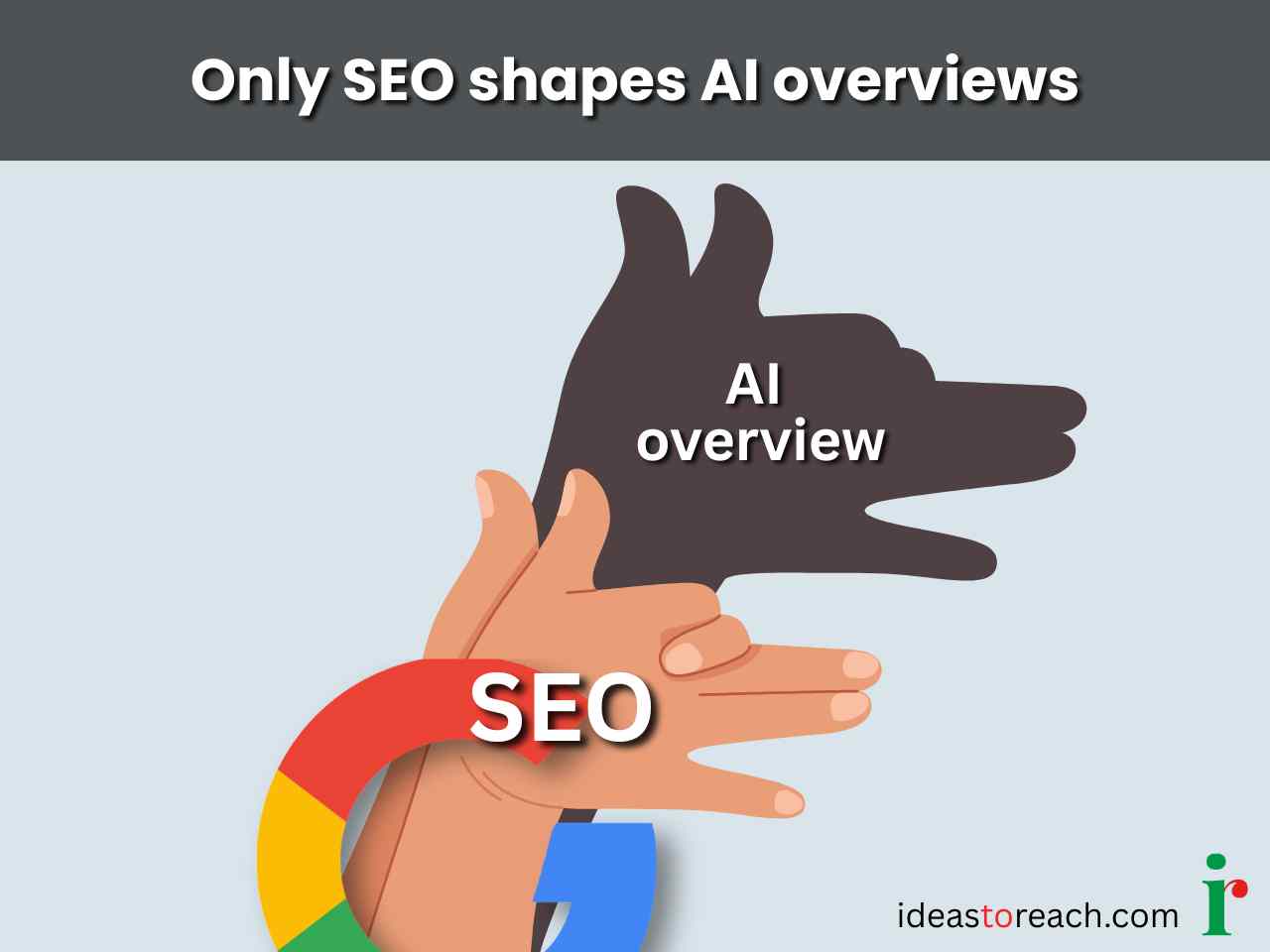
Open any marketing newsletter, LinkedIn feed, or SEO conference agenda in mid-2026 and you'll hear some version of the same warning: if your brand isn't showing up inside Google's AI Overviews or getting mentioned by ChatGPT, Gemini, or Perplexity, you're already losing. Entire consulting practices have been built around "Generative Engine Optimization" (GEO). Budgets are being redirected from proven SEO work toward chasing AI citations that nobody can even verify are working.
We think this warning is, at best, a wild overcorrection - and at worst, actively bad advice dressed up as urgency. Not because AI Overviews aren't real or aren't changing search behaviour. They are. But because the warning conflates two very different things: losing clicks on broad, informational searches (true, well documented, and serious) and losing business on high-intent, local, transactional searches (not supported by the data we're about to show you).
We manage the digital marketing for two real, growing Chennai real estate brands - DRA Homes and NuTech - and we pulled the actual Search Console and Google Ads numbers before writing a single word of this post. No assumptions where real numbers exist. Here's what they show.
Go straight to the Essence of this blog for a quick read
To be fair to the other side of this argument, the underlying statistics aren't invented. BrightEdge's tracking shows AI Overviews now appear on roughly 48% of all queries as of early 2026, up sharply from about 31% a year earlier, and Seer Interactive's research found organic click-through rates on the top-ranking page dropping by around 61% on queries where an AI Overview appears Brands cited inside an AI Overview do see meaningfully more clicks than uncited brands on the same page - but everyone on that page still gets far fewer clicks than they would have without any AI Overview at all.
That's the real, measured trend. It's happening. Nobody serious is disputing it.
Here's what gets lost in the panic, though, and this is the part almost nobody in the GEO conversation mentions: BrightEdge's own industry breakdown shows this impact is wildly uneven. Real estate, shopping, and arts-and-entertainment queries remain among the least affected categories in the entire dataset - AI Overviews appear on fewer than 3% of keywords in those categories, compared to 83% in education and 82% in B2B technology Separate research from BrightLocal found local search traffic barely moves at all - roughly a 3% decline - because AI Overviews rarely trigger for "[service] + [city]" style searches in the first place
Read those two findings together and the picture becomes obvious: the queries losing clicks to AI are overwhelmingly broad, informational ones - "how does X work," "what is Y." A real estate search like "flats in Chennai for sale" or "flats in Porur for sale" is neither broad nor informational. It's local, transactional, and exactly the kind of query Google's own data says AI Overviews barely touch. Given Google earns a meaningful share of its ad revenue from the real estate industry, this isn't a coincidence - it's Google protecting its own commercial search inventory.
DRA Homes, one of the top real estate companies in Chennai, sells residential flats and villas across the city. We looked at their Search Console performance for a roughly three-and-a-half-month window, from 1st April to 18th July 2026.
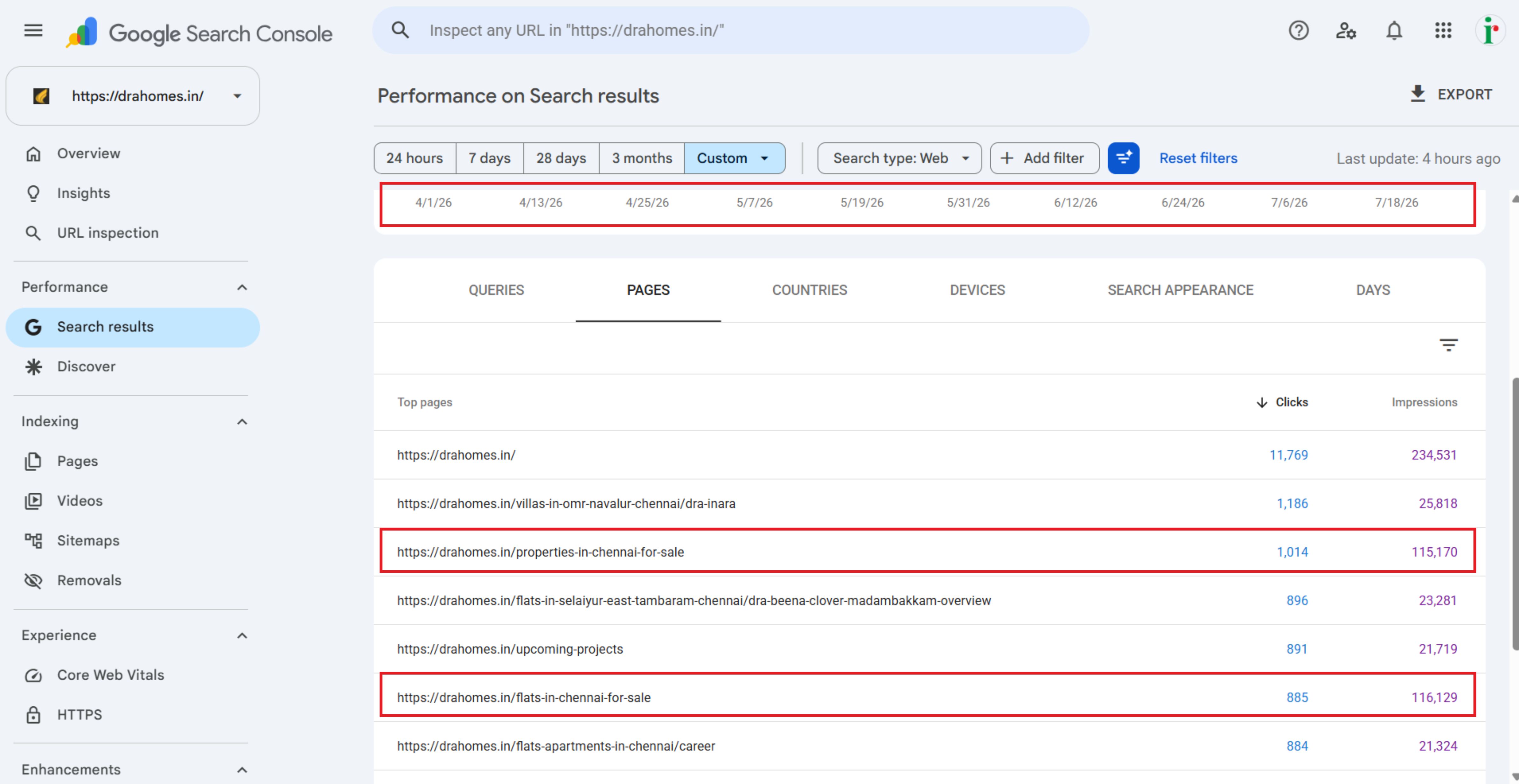
DRA Homes: Search Console performance, April-July 2026
The homepage, unsurprisingly, performs strongly: 234,531 impressions and 11,769 clicks. That's expected - it's the brand's front door.
What's genuinely remarkable is what happens on the two pages we built specifically around high-intent search terms: /properties-in-chennai-for- and /flats-in-chennai-for-sale.
properties-in-chennai-for-sale: 115,170 impressions, 1,014 clicks
flats-in-chennai-for-sale: 116,129 impressions, 885 clicksAdd those two pages together and you get 231,299 impressions - almost exactly matching the homepage's 234,531. Two individual, deliberately built SEO pages, targeting specific buyer-intent phrases, are pulling in nearly as much visibility as the entire brand's homepage combined. That is what structured SEO is supposed to do: build additional front doors, each matched to exactly what a real buyer is typing into Google.
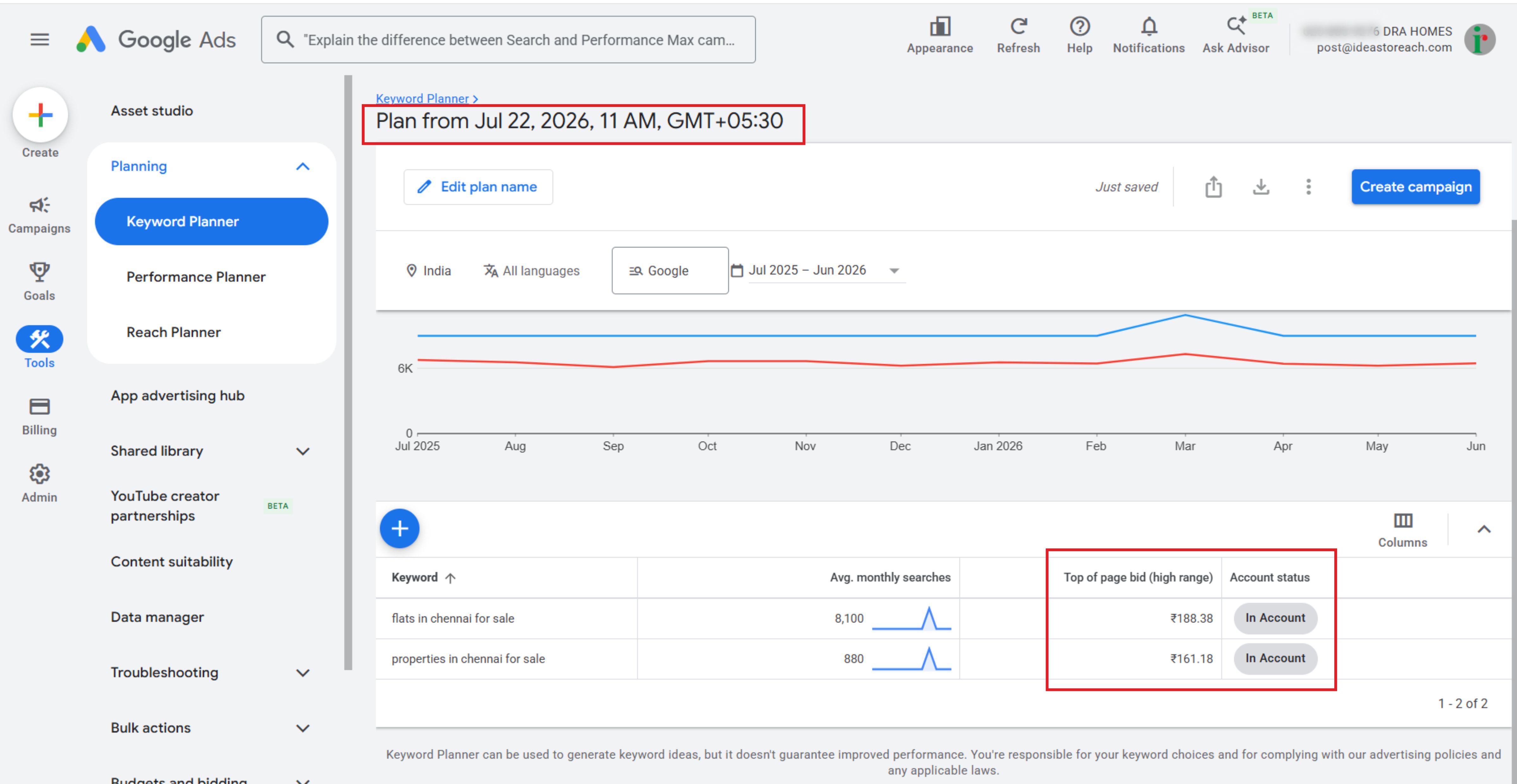
DRA Homes: Google Ads top-of-page bid data for the same keywords
Now here's where the financial argument comes in. We pulled the actual Google Ads Keyword Planner data for the same two search terms, as of 22nd July 2026:
This is the amount Google itself would charge DRA Homes to buy a top-of-page ad position for these exact searches. We can now calculate, with no assumptions at all, what it would have cost to buy the clicks SEO delivered for free.
NuTech, a fast-growing real estate brand in Chennai with signature residential projects, is building strong momentum in the Porur corridor. The pattern here is, if anything, even more striking.
Over the same date range, NuTech's homepage recorded 30,717 impressions and 2,846 clicks. The page built around one specific buyer-intent phrase, /flats-in-porur-for-sale, recorded 29,000 impressions - nearly identical to the homepage - with 959 clicks.
A homepage naturally accumulates impressions from brand searches, navigational searches, and general curiosity about the company. A single interior page, targeting one specific commercial phrase, matching that volume almost exactly is a sign the SEO work is doing exactly its job: intercepting a buyer at the precise moment they're searching for what NuTech sells.
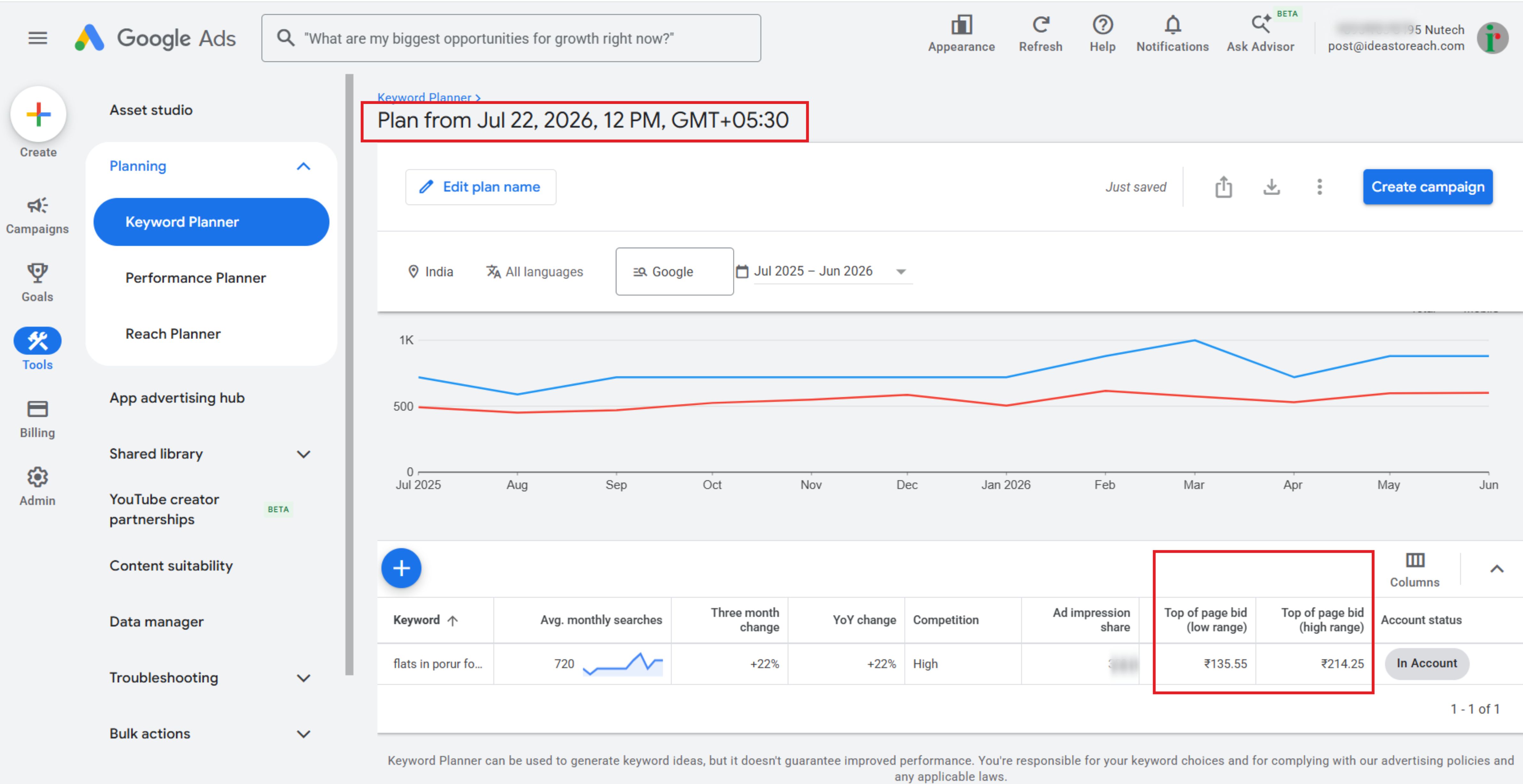
NuTech: Google Ads top-of-page bid range for the same keyword
The Keyword Planner data for "flats in porur for sale," pulled on 22nd July 2026, shows a top-of-page bid range of ₹135.55 (low) to ₹214.25 (high).
For all the panic about needing a separate GEO strategy to get cited inside AI Overviews, DRA Homes' and NuTech's results suggest something simpler: build genuinely strong, well-structured SEO content, and the AI Overview citations tend to follow on their own.
Search "porur infrastructure" today, and Google's AI Overview cites NuTech Projects directly, twice, within its own answer - and the organic result sitting right below the AI Overview is NuTech's own blog post on that exact topic, ranking first.
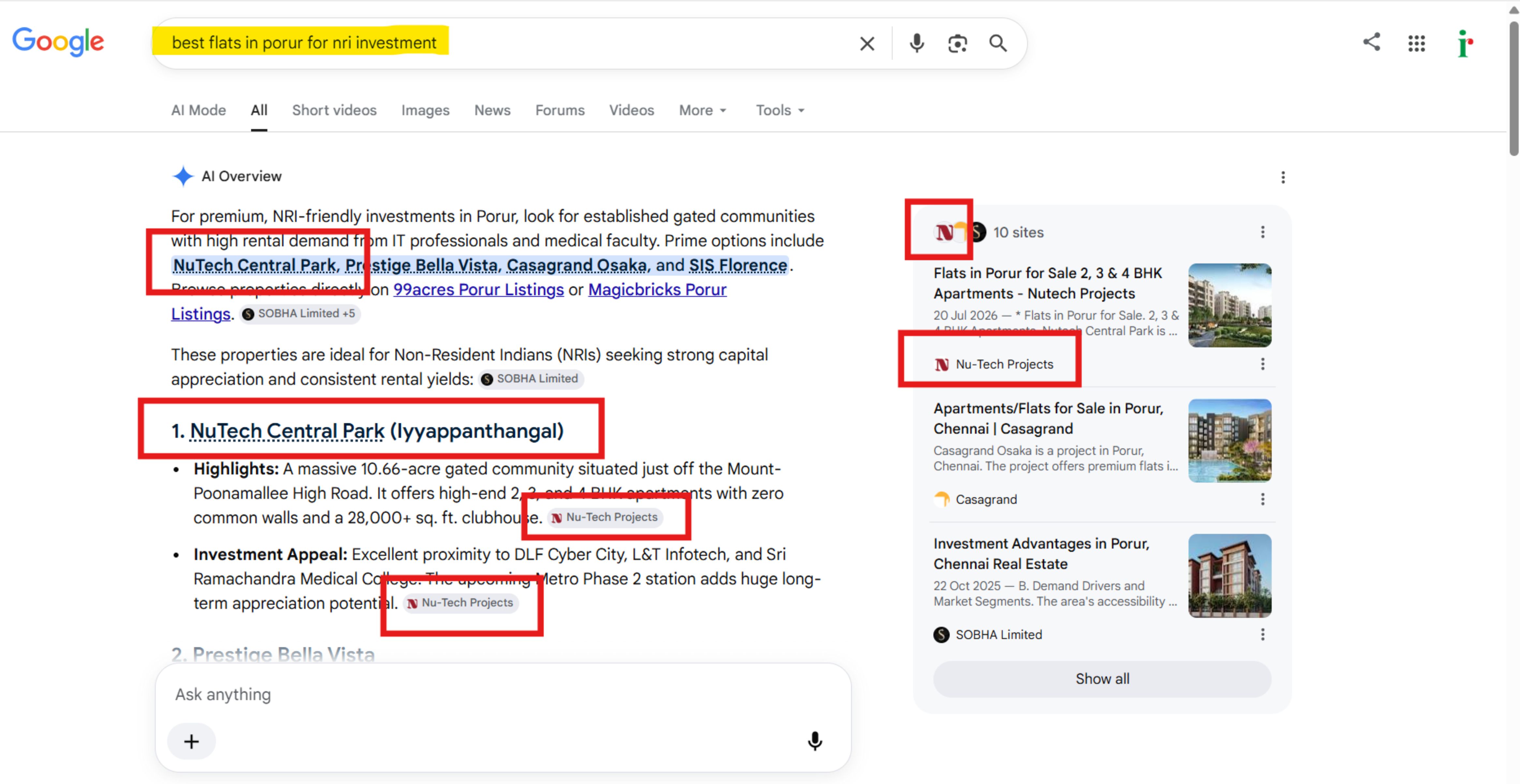
NuTech Central Park named the top pick in Google's AI Overview for NRI flat investment in Porur
Search "best flats in porur for nri investment," and NuTech Central Park is the AI Overview's top recommendation, with NuTech Projects cited as a source three separate times in the same answer, alongside established names like Casagrand and Sobha in the "10 sites" panel.
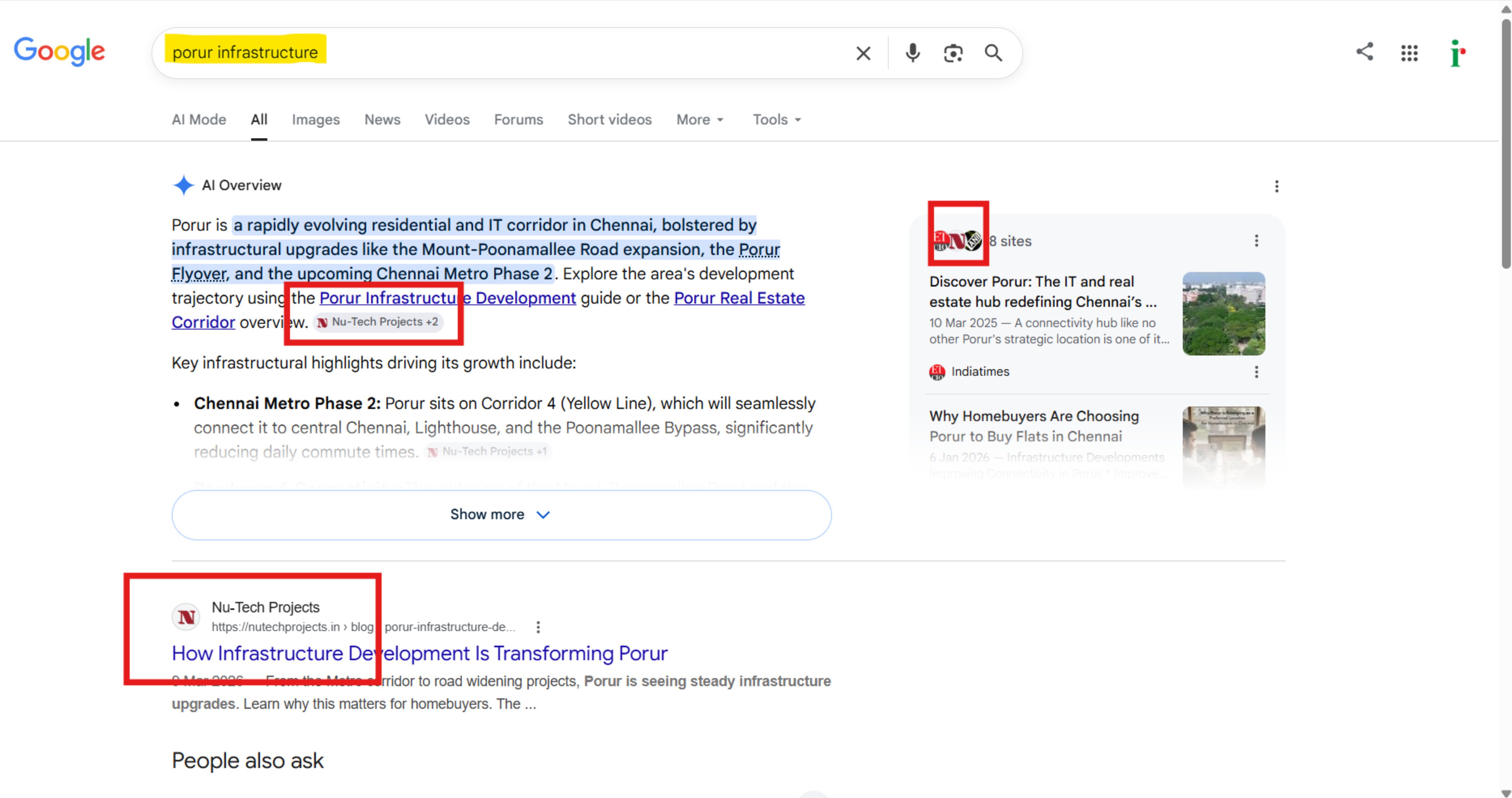
Google's AI Overview cites NuTech Projects directly for "porur infrastructure"
The same pattern holds for DRA Homes. Search "new residential projects near global sports city chennai," and DRA Homes is cited inside the AI Overview itself for two separate projects, and again in the "7 sites" panel.
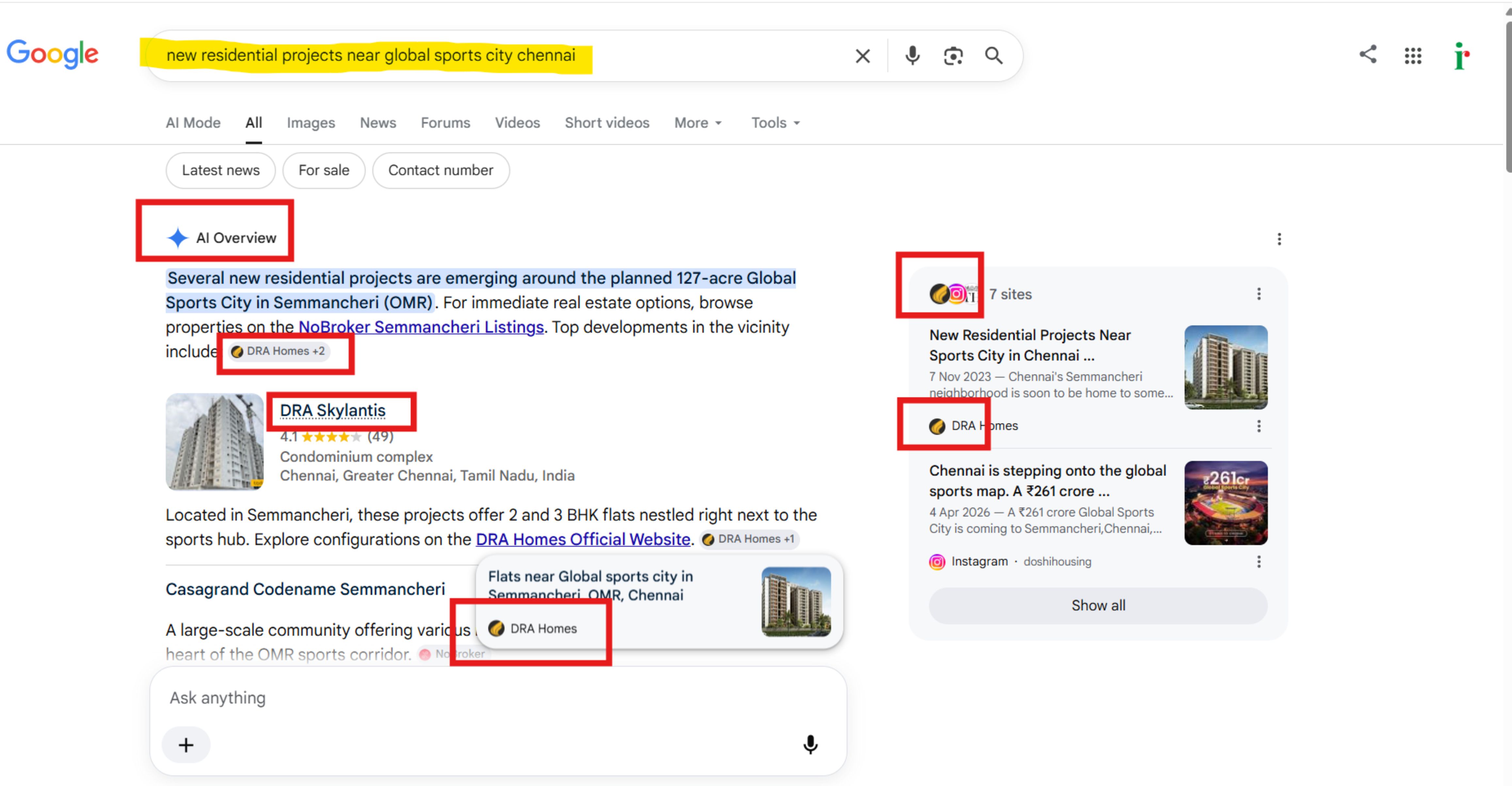
DRA Homes appears inside Google's AI Overview for new residential projects near Chennai's Global Sports City
Search "nri real estate investment in chennai" - a genuinely competitive, high-value keyword - and DRA Homes doesn't just get cited inside the AI Overview, it holds the #1 organic listing directly above it, with the AI Overview linking straight back to DRA Homes' own guidance page.
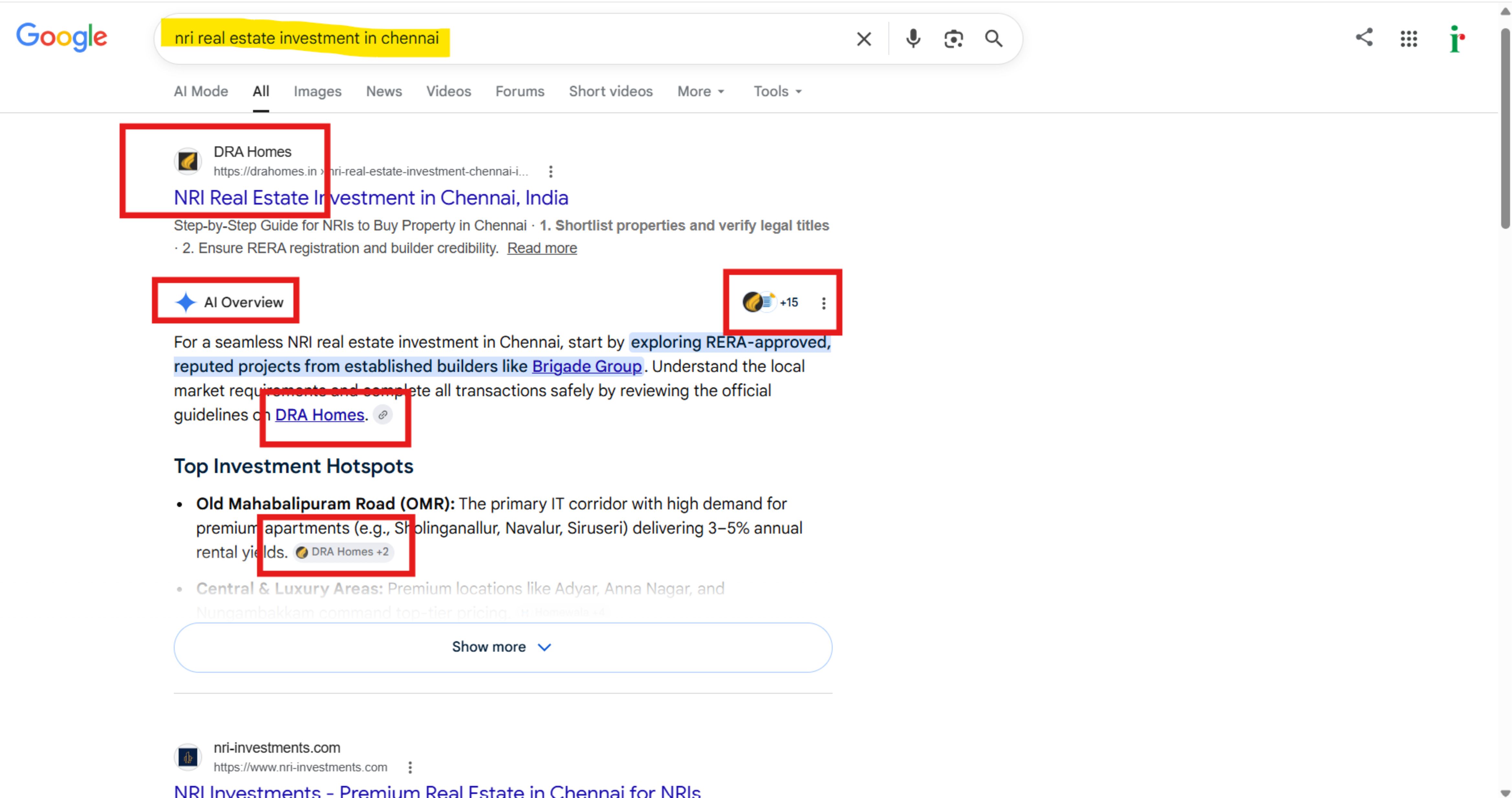
DRA Homes holds the top organic result and the AI Overview citation for NRI real estate investment in Chennai
Nobody ran a "get cited in AI Overviews" campaign for either brand. Nobody built citation-bait content or paid a GEO consultant. What earned these citations was the same structured, topic-authoritative SEO content built to rank organically in the first place. If your organic SEO is genuinely strong on a topic, you very likely already show up inside the AI Overview for it too - chasing a separate GEO budget on top of that is often solving a problem good SEO has already solved.
| Client | Page / Keyword | Clicks | Top-of-Page Bid | Cost Saved |
| DRA Homes | Flats in Chennai for sale | 1,014 | ₹188.38 | ₹1,91,017 |
| DRA Homes | Properties in Chennai for sale | 885 | ₹161.18 | ₹1,42,644 |
| NuTech | Flats in Porur for sale (low range) | 959 | ₹135.55 | ₹1,29,992 |
| NuTech | Flats in Porur for sale (high range) | 959 | ₹214.25 | ₹2,05,466 |
| Total (using NuTech's midpoint bid of ₹174.90) | ₹5,01,393 |
That number isn't a guess about "brand value" or "trust premium." It's Google's own advertised price for the exact same clicks, multiplied by the exact number of clicks Search Console recorded - over ₹5 lakh in advertising cost saved, across just three pages, on two client accounts, in roughly one financial quarter.
Everything above answers "what would this have cost as an ad." It doesn't answer "what is an organic click actually worth" - because organic traffic converts differently than paid traffic, and that deserves its own honest treatment.
Table - Estimated Organic Click Value (data range: 1 April – 18 July 2026; an industry-style estimate)
(Basis: a commonly cited 3-5x multiplier on paid-click cost, reflecting organic's higher trust and conversion rate — an estimate, not a measured figure.)
| Client | Page / Keyword | Clicks | Estimated Value per Click | Estimated Total Value |
| DRA Homes | Flats in Chennai for sale | 1,014 | ₹400–₹950 | ₹4,05,600–₹9,63,300 |
| DRA Homes | Properties in Chennai for sale | 885 | ₹400–₹950 | ₹3,54,000–₹8,40,750 |
| NuTech | Flats in Porur for sale | 959 | ₹400–₹950 | ₹3,83,600–₹9,11,050 |
Table — AI Overview / Chatbot Value Benchmarks (general industry-wide claims, not specific to any search term used in this post)
| Metric | Estimate Value | Scope | Basis |
| Organic click (general industry framing) | ₹300–₹500 | Claimed to apply universally | The pattern is real; the flat figure isn't term-specific |
| AI Overview brand citation | ₹150–₹250 | Claimed to apply universally | An estimate, not tied to any published measurement |
| Chatbot mention (ChatGPT / Gemini / Claude / Perplexity) | ₹800–₹1,500+ | Claimed to apply universally | An estimate, not tied to any published measurement |
A genuine per-click value for "flats in Chennai for sale" almost certainly differs from one for an unrelated informational query - yet this framework assigns the same number to both. That flatness is itself a sign these figures were reasoned out, not measured.
Much of the AI-visibility panic leans on a metric called "share of voice" - how often your brand's product appears in an AI answer compared to competitors. On paper it sounds like a real competitive benchmark. In practice, it's close to meaningless: if an account doesn't have enough impressions, share of voice simply displays as zero - not because the brand is losing, but because there isn't enough data to calculate anything. If the account has no competitors defined at all, it displays as a flat 100% - not because the brand is dominating, but because there's nobody to compare against. A number that can read 0% or 100% for reasons that have nothing to do with actual performance isn't one a serious marketer should be making budget decisions around.
And yet the frenzy continues. Everywhere you look, brands are being told to chase AI Overview citations and chatbot mentions as though the entire future of demand generation depends on it. What's rarely said out loud is why the volume of this message keeps rising: a great deal of money has already been invested - by platforms, by tool vendors, by consultants who've built entire practices around GEO - and that investment needs to show a return. Until it does, the "sky is falling" signal will keep being sent, because too many people now have a financial stake in everyone believing it.
Meanwhile, composed and disciplined brands like DRA Homes and NuTech aren't chasing the frenzy. They're not ignoring AI visibility either - sensible technical hygiene costs nothing and is worth doing. But they're not redirecting real budget away from what is actually, measurably working. The tables above show exactly what happens when a brand keeps its head while the rest of the market runs: they keep gaining ground, keep converting real clicks into real leads, and keep their marketing spend pointed at the channel that has never stopped producing evidence.
There's an old saying worth applying here: don't add salt to the sea. Pour a sack of salt into the ocean and nothing changes - the sea doesn't taste any saltier, and you have no way of proving your sack ever went in. That's the real risk of shifting genuine marketing budget toward AI Overview citations and chatbot mentions right now. You can invest, you can optimize, you can pay consultants to chase visibility - but with no available click data, no conversion tracking, and no independent measurement standard, you will never actually know whether that investment moved anything. The sea absorbs it silently. We've made this same point before about automated bidding that promises results without giving you visibility into what's actually driving them - the same discipline applies here.
This isn't a call to ignore AI visibility altogether. Reasonable, low-cost technical hygiene - clean schema, well-structured content, an accurate business presence - costs little and carries no real downside. But treat any significant spend beyond that with the same discipline you'd apply to any other investment: ask for the measurement first, and only commit real money once there's a way to verify the return. Right now, for AI Overview citations and chatbot mentions, that measurement doesn't exist yet - not from any vendor, not from Google, not from OpenAI. Spend prudently until it does.
This post is built on two clients, one industry, one city. DRA Homes and NuTech are both Chennai real estate brands, and the BrightEdge data above confirms real estate is one of the categories AI Overviews barely touch. A publisher, an e-commerce brand, or an informational content site could reasonably read this and say "that's real estate, not my business" - and they'd have a fair point. The distinction that matters isn't the industry, it's the query type: local, transactional, decision-stage searches behave very differently from broad, informational ones, in every category, not just real estate. If you want to know where your own business sits on that spectrum, that's worth checking with a proper website and online visibility audit rather than assuming either way.
See our advanced SEO solutions in Chennai — the same evidence-based approach shown throughout this post.
 Link Copied!
 Only SEO grows business. The sky won't fall if you're missing from AI Overviews.
Viswanathan Ganesan, Managing Director of Ideas to Reach India Pvt. Ltd., is a hardcore advertising professional since 1982. He comes from the labs of Ogilvy and has also worked for institutions with assistance from UNCTAD. He brings global expertise in Google Ads and SEO to businesses across real estate, banking and finance, telecom, healthcare, hospitality, education, and FMCG. Connect with him on LinkedIn.



Please send a WhatsApp message only. Kindly do not call :
+ 91 - 99 4040 1010 | + 91 - 94 97 40 1010
Email: [email protected]