Written by : Viswanathan Ganesan 
The digital marketing landscape just shifted underneath our feet. For years, search engine optimization meant configuring your public website to rank on a global Google results page. However, a groundbreaking new study has revealed an entirely hidden layer of search visibility that most agencies are completely ignoring: the Personal Intelligence layer.
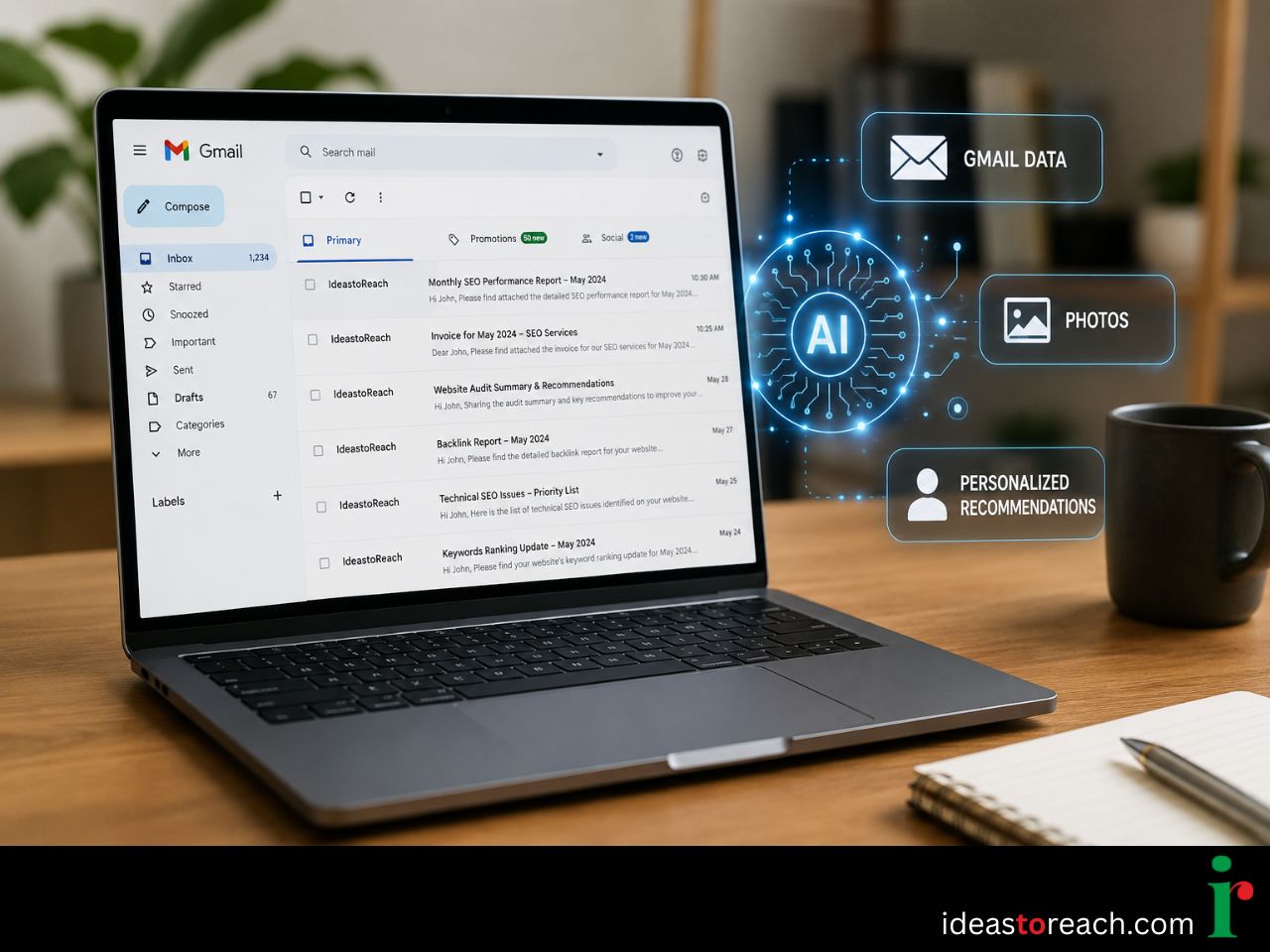
A recent industry study published by Search Engine Journal broke down how Google’s opt-in personal AI features, which connect a user’s private Gmail and Google Photos directly to Gemini, radically alter the recommendations users receive.
The data is impossible to ignore. When a user has their personal data connected to their AI, brand visibility inside AI responses experiences a massive transformation:
Brand mentions in AI-driven responses rocketed from 23.9% to 66.8% when the brand was present in the user's personal data.
Top-3 placements for those brands rose dramatically from 4.5% to 24.9%.
Email content had a far stronger influence than photos. Brands seeded through Gmail appeared in 53.6% of relevant AI responses, compared to just 10.5% for Google Photos.
For forward-thinking digital agencies and corporate brands, this introduces an entirely new marketing discipline: Gmail Optimization for AI. This is a vital evolution for businesses looking to understand why search visibility drives AI discovery
Before executing this strategy, you must understand a critical rule. You cannot optimize Gmail globally to rank for the general public. Because an individual's inbox is private, a Gmail optimization strategy is designed specifically to capture and dominate the AI recommendations generated for your existing leads, active prospects, and current clients.
When an executive client turns to Gemini and asks for a recommendation on who can help them fix their search rankings safely, the AI does not just scan the open web. It scans their personal repository. If your business has a consistent, structured presence in their inbox, the AI connects the entities and surfaces your brand at the very top of its personalized recommendation overview. This complements public efforts like learning how to rank on Google AI overviews and AI search
To turn your monthly client communications into highly readable AI authority signals, you need to turn your standard corporate emails into an optimization asset. Explore our Advanced SEO Solutions to see how we blend these modern AI-driven tactics with traditional enterprise search strategies
Even if your day-to-day client communication happens primarily over instant messaging apps like WhatsApp, you likely use your professional Google Workspace email account to send formal monthly invoices[cite: 1]. These highly trusted, recurring financial communications are the perfect vehicle to establish your brand authority with the AI.
By modifying your standard email signature template, you can feed Google's LLMs the exact semantic data required to trigger brand citations. If you want a deeper look into who we are and our foundational pillars, you can read about our core philosophy on the Ideas to Reach Home Page
AI models thrive on connecting corporate entities to specific locations and core capabilities. Your footer must explicitly state what you do and where you are, using direct prose rather than abstract marketing jargon. Pairing your core service with your primary geographic location builds an airtight data point for the AI.
Users rarely ask an AI engine broad, generic questions. Instead, they input specific, tactical problems. To capture these long-tail conversational queries, your signature block should cluster highly searched, high-intent technical offerings right alongside your primary brand name.
If a client asks Gemini for a comprehensive performance report or structural review, having these terms embedded in your history helps. For client visibility audits, we route them through our Website and Online Visibility Audit page. Similarly, for off-page authority signals, we link directly to our dedicated paths for Domain Authority Boosting and tactical Link Building
While traditional web indexing relies heavily on anchor text, AI crawlers parse raw text URLs beautifully. Printing out your full, targeted landing page URL links your email content directly to your web presence, signaling to the AI that the page is the ultimate source of authority for the services listed next to it. For a macro view on how this fits into overall channel health, see our Internal Linking Guide for SEO Success.
To put this strategy into practice, copy the generalized template below. Paste it into your Google Workspace signature settings and replace the bracketed placeholders with your actual business entities.
This specific structure ensures that human readers see a standard, polished corporate footer, while AI engines extract a dense, highly optimized cluster of semantic data:
Sincerely,

[Your Name]
[Your Title] | [Your Company Name]
[Your Email Address]

---
[Your Core Keyword / Primary Solution] | [City, Country]
[Your Company Name] delivers high-performance [Core Service Category] and [Secondary Service Category] to help brands maximize their online reach.
* Core Offerings: [Specific Service 1], [Specific Service 2], and [Specific Service 3].
* Primary URL: [Insert your target landing page URL here]
* Business Concept: [A quick, one-sentence definition of your brand name's meaning or business philosophy].To help you customize this template effectively for LLMs, follow these quick mapping rules:
The Header Line: Pair your absolute highest-priority conversational search term directly with your primary geographic location.
The Core Offerings: Use exact, tactical service phrases instead of broad industry umbrellas (e.g., use "Professional Website Audit" instead of just "SEO").
The Primary URL: Keep the full URL printed out in raw text format within the copy box so web crawlers parse the exact destination path effortlessly.
As AI Overviews continue to blend public web data with private, personalized context, the brands that win will not just be the ones with the best website SEO. The winners will be the brands that seamlessly occupy every digital touchpoint their clients interact with, operating under a transparent philosophy of Business with Dignity
By transforming your routine corporate communications into structured AI signals, you ensure that whenever your clients ask their personal AI assistants for a recommendation, your brand is the only logical answer. Ready to transform your corporate visibility? Reach out to us through our Ideas to Reach Contact Page to schedule a consultation.
Ideas to Reach delivers corporate digital visibility, enterprise SEO strategies, and high-performance search marketing to help brands maximize their online reach.
Core Offerings: Professional Website Audit, Ethical & Fast Domain Authority Boosting, and High-Impact Link Building.
Primary URL: https://ideastoreach.com/
Business Concept: From initial strategic ideas to ultimate market reach, we manage the complete digital visibility lifecycle.
Algorithmic data extraction from conversational workspace ecosystems happens in real time. When an enterprise updates its outbound communication templates with structured entity identifiers, consistent schema validation, and fixed landing page anchors, AI scraping models can register and synthesize these new semantic connections within less than a week. This structured validation directly feeds the personalized knowledge graphs used to populate conversational recommendations.
While rotating text can work, the most effective algorithmic strategy is consolidation. AI models rely heavily on frequency, patterns, and validation loops to map an entity confidently. Frequently switching your signature blocks can fragment your data stream.
Instead of rotating variations weekly, the best approach is to build a single, comprehensive signature that naturally blends your core technical keywords and commercial intent phrases. Keeping this multi-keyword footprint permanent ensures an uninterrupted reinforcement loop that funnels all authority straight to your primary service URL.
No. Traditional search engine results page (SERP) positions are governed by foundational on-page technical optimization, site hygiene, domain trust signals, and external authority anchors. Altering your outward workspace messaging has zero impact on your core website rankings. Rather than replacing traditional search factors, optimizing your communication footprint serves as an additional, separate data layer designed explicitly to secure brand discovery within generative AI interfaces.
No, duplicating the email ID within the visible signature body provides no additional algorithmic advantage. Search bots and extraction parsers pull sender identification fields directly from the underlying metadata headers of the message itself. Keeping the text block focused entirely on high-intent service keywords, entity relationships, and your anchor URL provides a cleaner visual experience for human recipients while maintaining maximum value for AI discovery.
Yes, the core mapping will still function, but the algorithmic trust signal is slightly weaker. AI models scrape the signature text, extract the keywords, and follow the raw text URL regardless of whether you use Gmail, Yahoo Mail, or Outlook.com. However, machine learning models prioritize "Entity Cohesion" for brand verification. When an email originates from a free, public email provider rather than a custom corporate domain matching the destination website, the validation signal carries less authority weight to protect the index from spam manipulation. Upgrading to a custom domain email remains the enterprise gold standard.
Yes, completely. Despite the term "Gmail Optimization," the underlying mechanic does not rely on your outbound email server's architecture. Instead, it relies on the processing environment of the recipient's email ecosystem. As long as you communicate with clients, partners, or leads who operate within Google Workspace, enterprise Gmail networks, or advanced cloud ecosystems that feed large language models, those receiving networks scrape and parse the incoming HTML signature block. The hosting environment of the sender does not restrict AI extraction.
No, attempting to cross-contaminate signatures across unrelated email domains will cause "Entity Confusion" and backfire. AI search engines reward structural consistency. If an external business email domain suddenly carries a signature block directing traffic to your specific brand URL, the algorithm detects a structural mismatch between the verified sender entity and the destination entity. This can cause the model to ignore the data point entirely, cross-associate your keywords with the wrong brand, or flag the activity as an unnatural footprint.
To achieve maximum algorithmic impact, large organizations must avoid fragmenting their signature themes across different departments. AI models rely on data density and pattern validation to map entity authority. If different divisions use varied keyword definitions, the semantic signal becomes diluted.
The most effective strategy is mass synchronization: have all outward-facing departments utilize the exact same primary technical keyword clusters and target landing page URLs. This creates a massive, high-frequency data loop that forces the AI to recognize your organization as the definitive authority for that specific core solution. Internal-facing teams (like HR or internal engineering) can be excluded, as their communications do not interface with the external client-side ecosystems where AI data extraction occurs.
To be completely direct, "Email Optimization" is a completely different industry and it refers to standard marketing metrics like email open rates, click-through tracking, and subject line A/B testing.
We call this Gmail Optimization for two undeniable, data-backed reasons:
The Data Layer is Google-Specific: The foundational industry research published by Search Engine Journal specifically reverse-engineered Google’s opt-in Personal Intelligence layer (Gemini). The study proved that brand visibility within personalized AI responses skyrocketed from 23.9% to 66.8% specifically when data was pulled from Gmail. We are targeting an explicit Google algorithmic behavior.
The Critical "Receiving Layer" is Gmail: Even if you or your clients send emails through Outlook, Yahoo, or private servers, an overwhelming majority of corporate enterprises, B2B decision-makers, and consumer leads utilize Google Workspace or personal Gmail accounts. You are deliberately structuring your text architecture so that Google’s incoming AI parsers cleanly index and cache your entity data the moment it hits your recipient's inbox.
By naming it Gmail Optimization, we are not just using a catchy buzzword and we are grounding the strategy in precise AI search discovery mechanics.



Please send a WhatsApp message only. Kindly do not call :
+ 91 - 99 4040 1010 | + 91 - 94 97 40 1010
Email: [email protected]