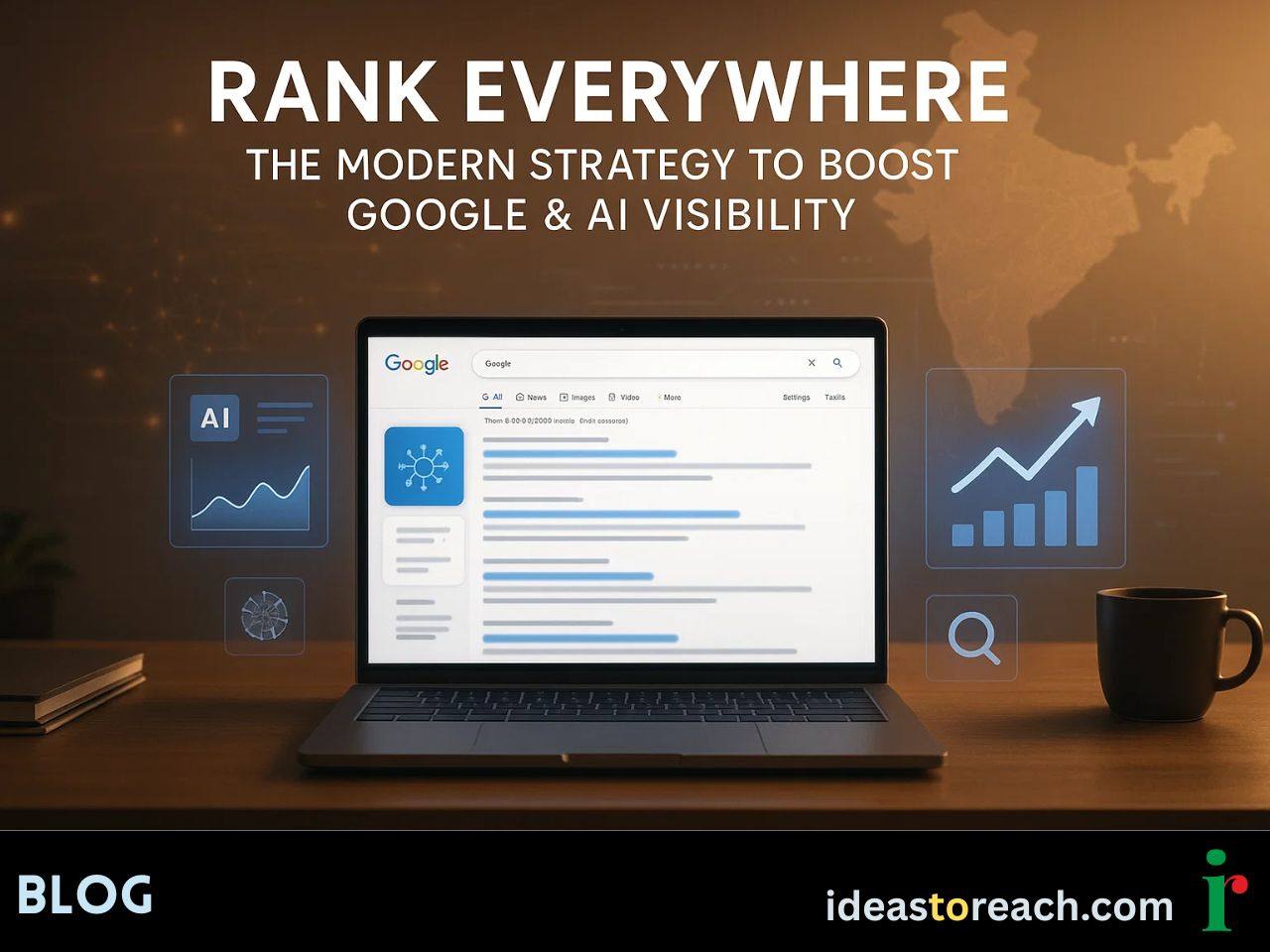
If we want to grow in 2025 and beyond, we must understand how to rank higher on Google in India across classic search results and new AI-powered experiences. At Ideas To Reach, we help Indian brands show up consistently in Google Search, AI Overviews, Gemini, and even tools like ChatGPT.
Search in India is no longer just 10 blue links; AI-powered SERPs, rich snippets, and Google AI Overviews (AIO) now shape how users discover brands. To rank higher on Google in India, we design content that works for both traditional ranking signals and AI SEO strategies, especially on mobile.
Indian users are mobile-first, so Core Web Vitals, page speed, and mobile-first indexing directly impact how to improve Google visibility. When we build SEO best practices for Indian websites, we treat technical performance, content relevance, and user experience as one integrated system.
Every project starts with a clear understanding of user intent. Before we think about keywords, we map SERP intent, such as informational, transactional, commercial, or local, to the right page types. For many clients who ask how to rank higher on Google in India, we combine local SEO in India, service landing pages, and educational blogs tailored to Indian search behaviour.
We then build a hub & cluster models around core themes, so Google sees strong topical authority rather than isolated posts. This supports entity-based SEO and helps us answer long-tail queries, such as how to get more visibility on Google in India without creating thin, repetitive content.
Google ranking factors for 2026 in India are moving toward quality, trust, and real-world usefulness. Technical health remains critical, as clean crawlability & indexing, logical internal linking, and fast-loading pages are supported by tools such as PageSpeed Insights and Google Search Console. These ensure that Google can quickly discover, understand, and rank important pages.
On the content side, E-E-A-T (Experience, Expertise, Authoritativeness, Trustworthiness) is non-negotiable. We use experience-based content, case studies, and India-specific examples to send strong signals of content satisfaction that Google can measure, such as longer sessions, deeper scroll, and higher engagement.

As LLM-driven search grows, the question is not only how to rank higher on Google in India but also how to rank in AI search results (Gemini + ChatGPT). AI systems value clear structure, rich entities, and topical depth and not just keywords. That is why we design content at the passage level, not just at the page level.
We use semantic SEO techniques and NLP / Entities / semantic relevance to cover topics comprehensively. This helps AI-powered SERPs understand where our content fits, so when your brand provides accurate, expert answers, it is more likely to be cited across multiple AI search surfaces.
Google AI Overviews (AIO) pull concise, well-structured passages from different pages to create instant summaries. To optimise for AI Overviews in Google, we place clear answer blocks near the top of sections, use descriptive headings, and ensure each segment can stand alone as a complete response.
We also use structured data and entity-focused copy to support Google Search AI Overview optimization. When users search for topics like how to rank higher on Google in India or how to optimise for AI Overviews in Google, well-marked content increases the chance that AIO highlights our brand. To dive deeper into the latest Google marketing innovations powering these features, we share regular insights in our posts.
Passage ranking has unlocked new opportunities for Indian websites with detailed content. Instead of creating dozens of short posts, we can structure one comprehensive guide and segment it with clear H2s and H3s. This is how we approach how to structure content for Google passage ranking in real projects.
Each section targets a specific question or long-tail query, supported by semantic keywords, internal linking, and logical flow. This passage-based ranking SEO approach helps us win visibility for multiple related queries, even when the whole page is not in position one.
To future‑proof visibility, we lean heavily into semantic SEO techniques. We identify key entities, like Google Gemini, Google Search Console, Core Web Vitals, structured data, and Local SEO India, and build content that clarifies how they connect. This entity-based SEO makes it easier for algorithms to interpret and trust our pages.
We then reinforce this with internal linking between related articles, tools, and service pages. Strong internal linking improves crawl paths, distributes authority, and guides users deeper into a topic, which strengthens topical authority over time.
Technical excellence is one of the fastest ways to improve Google visibility. We focus on mobile-first indexing, Core Web Vitals, and crawlability & indexing from day one. PageSpeed Insights helps us identify performance bottlenecks, while Google Search Console reveals indexing gaps and coverage issues.
Structured data plays a big role in AI-powered SERPs, featured snippets, and AI Overviews. By marking up FAQs, products, articles, and local business information, we help Google understand your content and increase the chances of enhanced SERP features. We have a detailed guide on structured data for AI Search that shows exactly how we approach this.
We also track visual search changes, including Google’s latest image SEO update. For e‑commerce and local brands, following the latest SEO update on consistent image URLs and alt text can make a real difference to discovery in image-rich results.
To improve content satisfaction signals Google tracks, we optimise for clarity and usefulness, not just length. We answer the main question quickly, provide supporting details, then offer clear next steps or related resources that keep users engaged.
We also balance human-written and AI-assisted content carefully. AI helps with research and outlines, but human editors bring local nuance, lived experience, and brand voice. If you are curious about this balance, we share a human vs AI content comparison that breaks down when each approach works best.
For small businesses, the question is often how to rank on Google without backlinks India. While high‑quality links still matter, we have seen Indian small businesses win with strong on-page optimization, local relevance, and consistent content. An SEO checklist for Indian small businesses usually includes:
An optimised Google Business Profile with accurate NAP, reviews, and photos.
City- or area-specific landing pages that match local SERP intent.
Fast, mobile-friendly pages supported by Core Web Vitals.
Clear internal linking between services, blog posts, and FAQs.
When combined with semantic coverage and query intent matching, these steps can drive meaningful visibility even with a modest backlink profile.
AI tools such as Google Gemini and ChatGPT often summarise content rather than send all clicks to individual websites. That is why we think beyond “position one” and focus on how to get more visibility on Google in India across all surfaces. Consistent brand mentions, structured passages, and coverage of related concepts such as AI-powered SERPs, LLM-driven search, and query intent matching help your brand appear more often in AI outputs.
We also monitor emerging features, like Google Chrome AI Mode and GA4 Analytics Advisor. GA4’s AI insights can reveal which pages perform best, where users drop off, and which topics drive the strongest engagement, helping us refine both current content and future topics. For a broader strategic view on whether AI will replace SEO or reshape it, contact our experts for more details.
When clients ask for the best SEO strategy for Indian websites in 2025, our answer connects everything:
Align every page with clear SERP intent and Indian context.
Use semantic SEO techniques and hub-and-spoke (hub & cluster) models to build topical authority.
Invest in Core Web Vitals, mobile-first indexing, and clean crawlability.
Optimise for passage ranking, AI Overviews, and featured snippets using structured data.
Track performance via Google Search Console, GA4, and content satisfaction signals.
This integrated approach is how we consistently work on how to rank higher on Google in India while also increasing visibility across AI search experiences. If you want a strategy shaped around your industry and city, our Google-approved digital marketing team in Chennai can support you with a tailored roadmap.
Focus on user intent, semantic SEO, fast mobile performance, helpful content, and technical health, consistently refining strategies based on analytics and evolving search trends.
Create clear, structured answer blocks, incorporate structured data, and demonstrate expertise through real-world examples to increase chances of being featured in AI-generated snippets.
Prioritize mobile responsiveness, local keyword targeting, topical content clusters, schema markup, and authoritative local signals such as reviews and citations for better visibility.
These tools prefer well-structured, semantic, and expert content to ensure your site offers in-depth, relevant information, which increases the likelihood of being referenced in AI summaries.
Typically, initial improvements appear within 2–3 months; stable, competitive rankings often require consistent effort over 4–6 months, depending on content quality and authority.



Please send a WhatsApp message only. Kindly do not call :
+ 91 - 99 4040 1010 | + 91 - 94 97 40 1010
Email: [email protected]