




Imagine you're searching online for a hotel room.
You find one that looks perfect. The location is convenient. The photographs are attractive. The price is ₹4,500 per night.
Then a message appears.
"Only 2 rooms left!"
Another follows.
"17 people are viewing this property right now."
Suddenly, you're in a hurry.
You weren't planning to book immediately. You wanted to compare a few hotels. But what if someone else books the room first?
You click.
By the time you reach the payment page, the price has increased. There are additional charges. Perhaps travel insurance has already been selected.
You didn't ask for it.
But you're already halfway through the booking.
Do you abandon it? Or do you pay?
Now imagine another situation.
You're searching for an apartment in Chennai.
An advertisement promises luxury apartments starting at ₹75 lakh.
You click, submit your phone number and receive a call.
The salesperson explains that the apartment at the advertised price is unavailable. However, another apartment is available at a considerably higher price.
Sounds familiar?
These experiences raise an uncomfortable question.
When we make decisions online, how often are we genuinely choosing and how often are we being pushed towards a decision?
India is now addressing that question through stronger consumer protection measures.
And the implications go well beyond online shopping.
For businesses, advertising agencies, digital marketers, e-commerce platforms and consumers, this deserves serious attention.
What Has India Changed and Why Should Digital Marketers Care?
On September 10, 2026, the Government of India announced the Consumer Protection (E-Commerce) (Amendment) Rules, 2026.
The amended rules are scheduled to come into force on January 1, 2027.
They strengthen the existing Consumer Protection (E-Commerce) Rules, 2020 and address several practices that have become familiar to online shoppers.
These include misleading price reductions, manipulated search results, insufficient disclosure of sponsored listings and deceptive website design.
The amendments also introduce or strengthen requirements concerning consumer complaints, seller information, consent for certain uses of consumer data and dark-pattern compliance.
Why now?
Consider the number of complaints.
According to the Ministry of Consumer Affairs, the National Consumer Helpline received 17,71,622 grievances during 2025.
Of these, 5,11,196, approximately 29%, were related to e-commerce.
That is more than half a million complaints associated with one sector.
Not every complaint necessarily involved deceptive marketing. Nevertheless, the figures demonstrate the scale of consumer concerns.
The government's response is intended to strengthen transparency and accountability in digital commerce.
But there is something important to understand.
These are amendments to India's e-commerce regulations, not a universal new advertising law covering every digital advertisement.
The legal obligations depend on the type of business and the scope of the applicable rules.
However, the underlying concerns are relevant across industries because misleading advertising and unfair commercial practices are also addressed by existing consumer protection and sector-specific laws.
And that brings us to the real issue.
Are We Really Making Our Own Choices Online?
Think about your last online purchase.
Did you buy something because you needed it?
Or because it was available at a 70% discount?
Did you choose a particular product because it was the best option?
Or because it appeared first in the search results?
Did you subscribe to a service because you wanted it?
Or because declining the offer was unnecessarily difficult?
There is nothing inherently wrong with persuasive advertising.
Marketing has always influenced consumer behaviour.
A shopkeeper recommends a product. A salesperson explains an offer. A television commercial introduces a brand.
Digital marketing does the same thing, but with one significant difference.
It can influence millions of people simultaneously, measure their responses and continuously adjust what they see.
A website can change the order of products.
An app can highlight one option while making another difficult to find.
A booking platform can introduce urgency through a countdown timer.
And all this can happen within seconds.
The consumer may believe the decision is entirely their own.
Sometimes it is.
Sometimes the website has already influenced much of that decision.
The question is not whether marketing should influence people.
Of course it should.
The question is whether that influence is based on accurate information or deliberately misleading impressions.
The Discount That May Never Have Existed
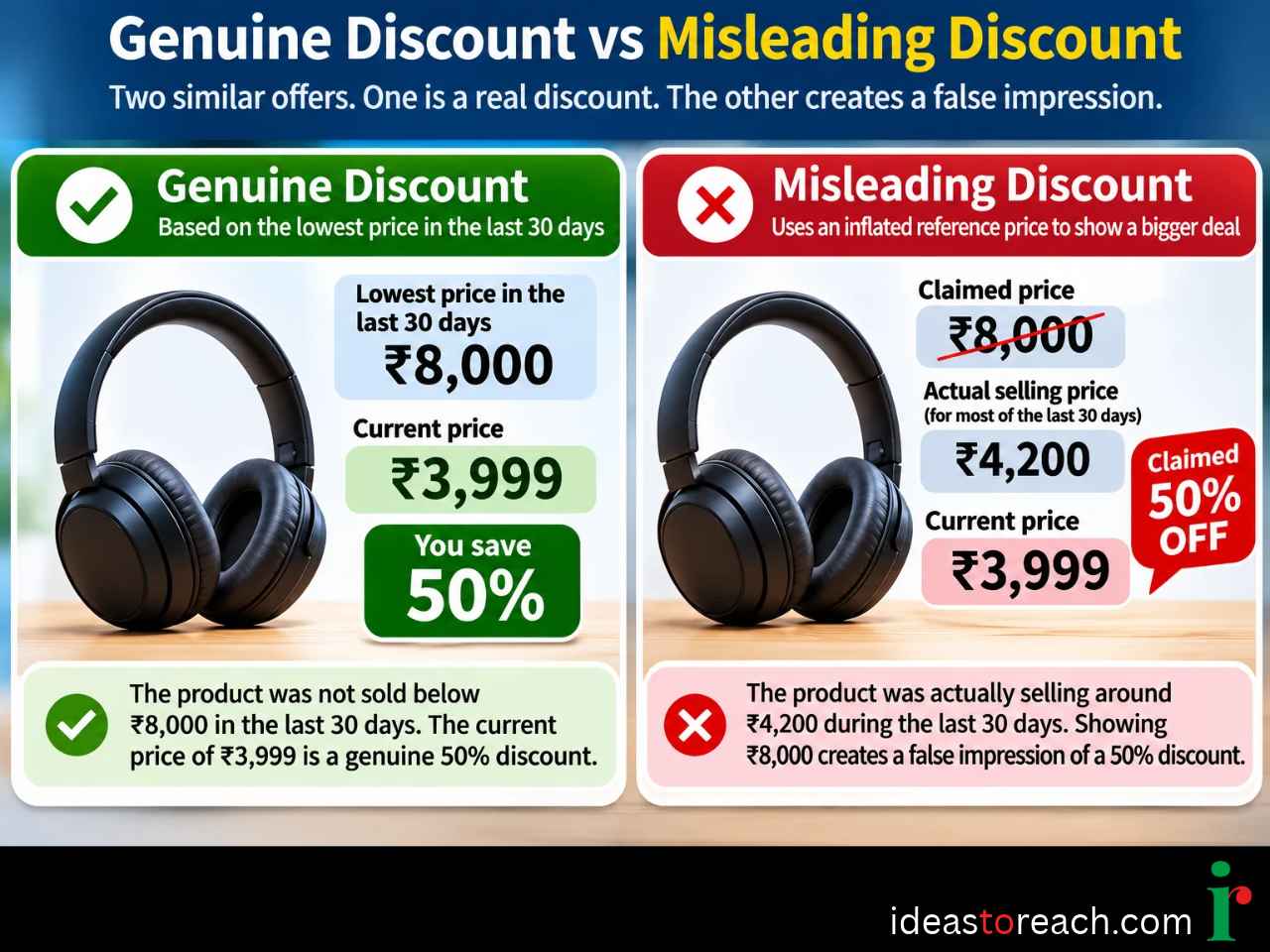
You see a pair of headphones advertised online.
Original price: ₹8,000.
Today's price: ₹3,999.
Savings: 50%.
That looks attractive.
But what if those headphones were selling for ₹4,200 throughout the previous month?
Is the discount really 50%?
Or has the higher reference price simply made the current price look more appealing?
This is one of the practices addressed by the new amendments.
When a price reduction is announced on an e-commerce platform, the amended rules require the reduced price and prior price to be displayed.
The prior price is defined as the lowest price at which the goods or services were offered during the 30 days preceding the announcement.
This changes how covered businesses must substantiate their discount claims.
What does this mean for digital marketers?
Consider an advertisement saying:
"Was ₹10,000. Now ₹4,999."
The creative team may produce an attractive banner.
The advertising platform may deliver thousands of impressions.
The campaign may achieve an excellent click-through rate.
But was the higher price genuine?
What does the pricing history show?
Can the business substantiate the claim?
Those questions matter.
The marketer's responsibility should not end with creating an advertisement that attracts attention.
The advertised claim must also be accurate and supported by the business.
An attractive design cannot make an inaccurate claim truthful.
Why Does One Product Appear Above Another?
Search for a smartphone on an online shopping platform.
Hundreds of options may appear.
But how many will you actually examine?
Five? Ten? Perhaps twenty?
Very few shoppers will examine every result.
The products appearing at the top enjoy a significant advantage.
Now comes the important question.
Why are they appearing at the top?
Is it because they closely match your requirements?
Because customers have rated them highly?
Because they are competitively priced?
Or because the seller has paid for additional visibility?
Paid promotion is a legitimate business practice.
The problem arises when commercial placement is presented in a way that makes consumers believe it is an independent recommendation.
The 2026 amendments prohibit e-commerce entities from manipulating search results in ways that mislead users or adversely affect relevance to their queries.
They also require sponsored listings to be clearly and prominently identified.
This does not mean paid placements are prohibited.
Nor does it mean platforms must reveal every technical detail of their ranking algorithms.
It means the presentation of search results should not mislead consumers.
Does this affect Google Ads and SEO?
This distinction is particularly important.
Google Ads, organic Google Search results and product rankings within e-commerce platforms are not identical systems.
The new e-commerce amendments should not be interpreted as a blanket prohibition on paid Google advertisements or legitimate SEO activities.
Google already identifies advertisements separately from organic search results.
Similarly, improving a website's content, technical performance, relevance and authority is not inherently deceptive.
A business can legitimately work to improve its visibility.
In fact, understanding how Google rankings work remains an important part of building sustainable online visibility.
The problem begins when visibility is achieved or presented through misleading claims, deceptive interfaces or misrepresented commercial relationships.
There is a difference between earning attention and misleading someone into giving it.
Dark Patterns: When Website Design Works Against the Visitor
Have you ever tried cancelling an online subscription?
Signing up took less than a minute.
Cancelling required searching through several pages, answering unnecessary questions and repeatedly confirming that you really wanted to leave.
Or perhaps you encountered a checkout page where an additional service was already selected.
You didn't ask for it.
You didn't even notice it initially.
But it was there.
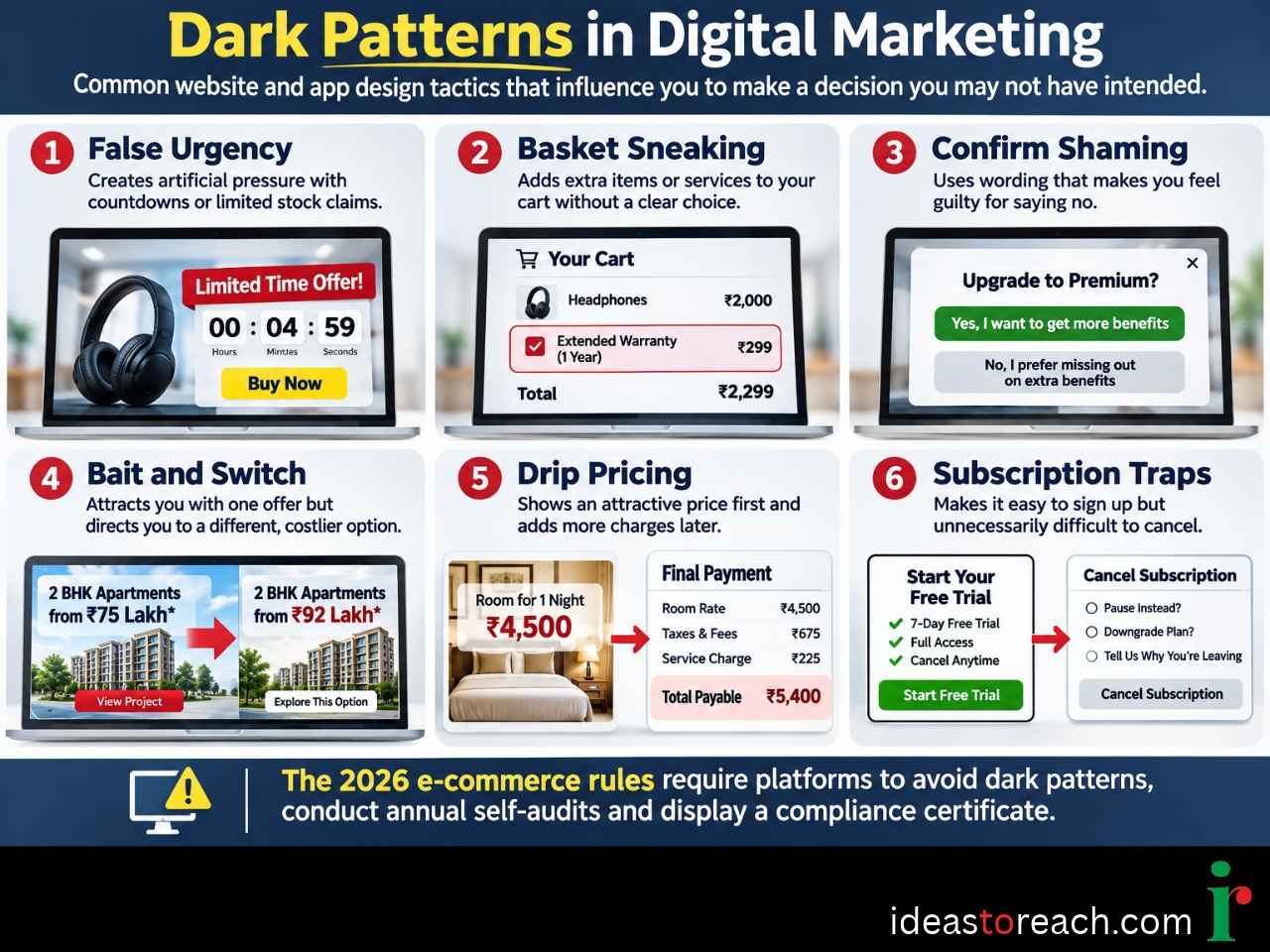
These are examples of what regulators call dark patterns.
Dark patterns are deceptive or manipulative interface practices that can influence people into making decisions they might not otherwise make.
India's Guidelines for Prevention and Regulation of Dark Patterns, 2023 identify 13 specified types.
Let's look at some familiar examples.
False Urgency
"Offer expires in 04:59."
You wait five minutes.
The timer resets.
The offer continues.
A genuine limited-period offer is not automatically a dark pattern.
A false countdown designed to create artificial pressure is another matter.
Basket Sneaking
You purchase a product for ₹2,000.
At checkout, an additional ₹299 service has been added without your affirmative selection.
You must remove it manually.
The business has made the customer responsible for rejecting something they never requested.
Confirm Shaming
A website offers a subscription.
The acceptance button says:
"Yes, I want to save money."
The rejection option says:
"No, I prefer wasting money."
The intention is obvious.
The visitor is being made uncomfortable about declining the offer.
Bait and Switch
An advertisement promotes a particular product or service.
You click expecting to receive it.
Instead, the website directs you towards something materially different.
Availability can genuinely change and legitimate alternatives can be offered.
But deliberately advertising an offer that the business does not intend to honour is a different matter.
Drip Pricing
The headline price looks attractive.
Additional mandatory charges appear only as the customer progresses.
The final amount is considerably higher than the price that encouraged the initial click.
By then, the customer has invested time and effort.
Abandoning the transaction becomes less appealing.
Subscription Traps
Signing up is simple.
Cancelling is unnecessarily difficult.
Important renewal terms may be unclear or buried within complicated instructions.
These practices illustrate why dark patterns matter.
They do not necessarily force people to buy.
They make saying no unnecessarily difficult.
The 2026 amendments require covered e-commerce entities to comply with the 2023 dark-pattern guidelines, conduct yearly self-audits and prominently display a certificate of compliance.
Can an Advertisement Explain Everything in Such Limited Space?
A digital marketer might raise a perfectly reasonable question.
"How can we explain every condition when Google Ads gives us just a few headlines and descriptions? Are we expected to put the entire offer into an advertisement?"
Of course not.
Advertisements have limited space.
Their purpose is to attract attention, communicate an offer and encourage interested people to learn more.
That is precisely why landing pages exist.
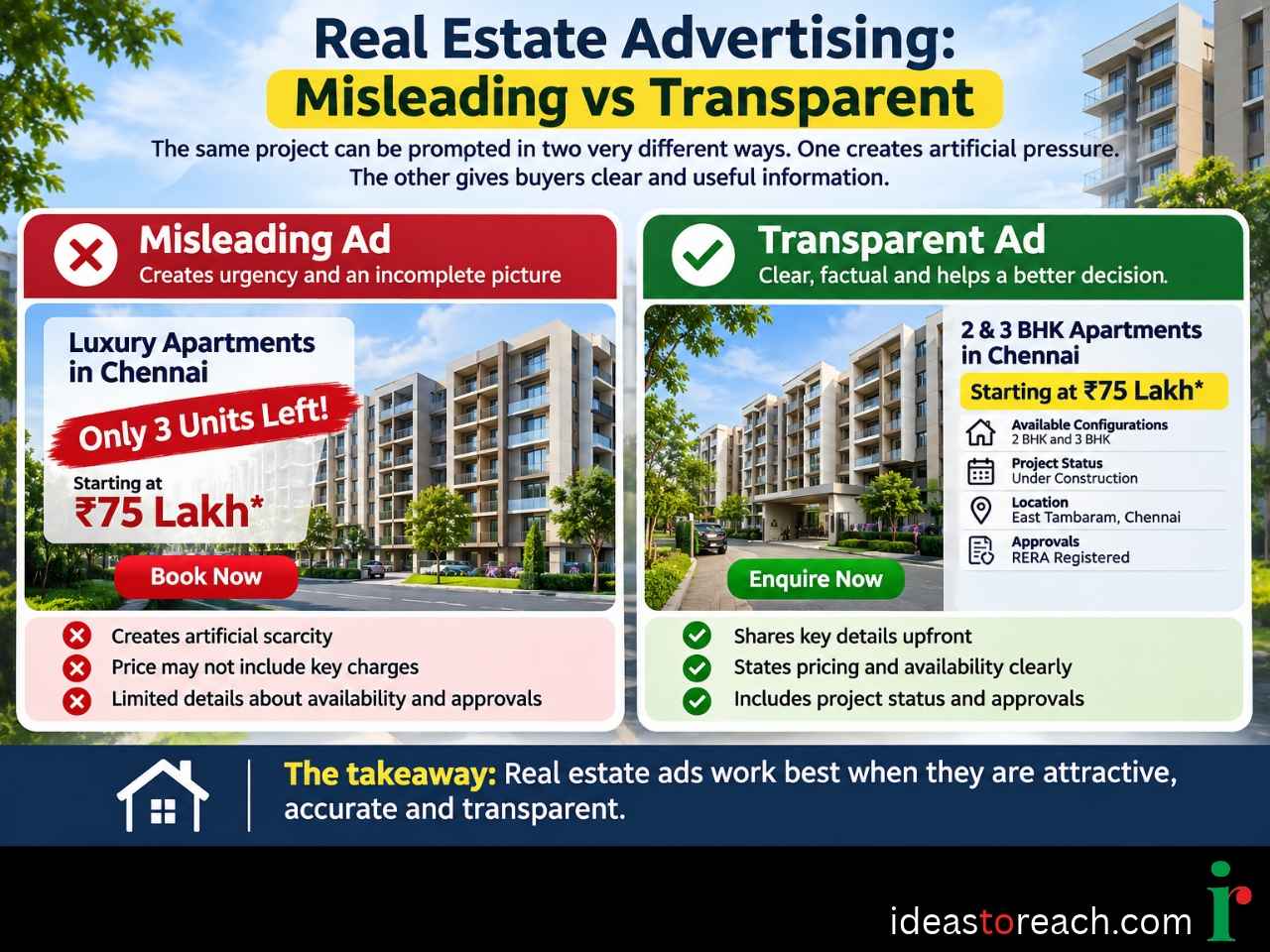
Imagine a property developer advertising:
"2 BHK Apartments Starting at ₹75 Lakh."
The advertisement cannot possibly explain every floor plan, payment schedule, additional charge and booking condition.
Those details can be provided on the landing page.
But there is one important condition.
An apartment must genuinely be available at the advertised starting price, subject to any clearly communicated qualifications.
Now imagine another advertisement:
"Get a Home Loan with Guaranteed Approval."
The visitor clicks and discovers that approval depends on income, credit history and the lender's eligibility requirements.
That is a different situation.
The landing page is not simply providing additional information.
It is qualifying a promise that should never have been presented as unconditional.
An advertisement can be brief without being misleading.
The distinction is simple.
An advertisement should communicate the offer truthfully.
The landing page should provide the details needed to understand it.
If an important condition fundamentally changes how a reasonable customer understands the advertisement, hiding that condition until after the click may not be sufficient.
Depending on the applicable law and advertising platform policies, some material qualifications may need to appear prominently in the advertisement itself.
This is not about forcing marketers to write lengthy advertisements.
It is about ensuring that the limited words they choose create an accurate impression.
After all, the purpose of a landing page is to explain the promise made in an advertisement, not to correct a misleading one.
Real Estate: When an Apartment Advertisement Creates Artificial Pressure
Real estate deserves particular attention.
Buying a home is not the same as purchasing a pair of shoes.
A homebuyer may be committing decades of savings, taking a substantial loan and making a decision that affects the entire family.
Yet property advertisements sometimes use the same psychological techniques found in everyday e-commerce.
Consider these messages.
"Only one apartment remaining!"
"Prices increase tomorrow!"
"Book now before the offer disappears!"
"Luxury apartments starting at ₹49 lakh!"
These statements may be legitimate when they are accurate, current and supported by evidence.
But what happens when they are not?
The Problem with Artificial Scarcity
Imagine a residential project with 200 apartments.
The advertisement claims only three units remain.
A prospective buyer feels pressured to make an immediate decision.
Later, the buyer discovers that many apartments are still available.
Perhaps the advertised scarcity referred only to a particular configuration or price category.
Perhaps the information was simply inaccurate.
Either way, it could materially influence the buying decision.
A more transparent advertisement would explain exactly what is limited.
For example:
"Three east-facing 3 BHK apartments available in the current release."
That is considerably more informative than an unexplained claim that only three homes remain.
The Problem with Incomplete Prices
An apartment is advertised at ₹75 lakh.
Later, the buyer discovers additional charges for parking, floor rise, maintenance deposits and other compulsory items.
Not every additional charge is unlawful.
The important questions are whether the advertised price creates a misleading impression and whether the required disclosures have been made.
In India, RERA requirements also play an important role in property advertising.
Developers and marketing agencies must consider those obligations separately from the 2026 e-commerce amendments.
Why Transparency Matters for Chennai's Real Estate Developers
Established real estate developers in Chennai, including DRA Homes, Appaswamy and Prestige Group, operate in a market where transparency in digital advertising is increasingly important.
From project approvals and pricing to availability and possession timelines, buyers expect clear and reliable information before making one of the biggest financial decisions of their lives.
Consider a buyer searching for apartments near a proposed or operational metro station.
An advertisement may highlight metro connectivity.
But is the distance accurate?
Is the station operational or proposed?
Does the travel-time claim reflect actual road access?
These details matter.
The same applies to claims about amenities, completion schedules, project approvals and available configurations.
A high-value purchase deserves more than an attractive headline.
It deserves accurate information.
And for developers, truthful advertising is not simply a compliance issue.
It is an opportunity to establish credibility before the first sales conversation begins.
Healthcare: When Advertising Influences Decisions About Health
Now consider someone searching online for medical treatment.
Perhaps they have recently received a diagnosis.
Perhaps they are looking for a specialist.
Perhaps they are comparing hospitals or diagnostic centres.
An advertisement appears.
"100% guaranteed cure."
Another promises:
"Best treatment in India."
A third says:
"Book today. Only two appointments remaining."
Healthcare marketing requires particular care because the audience may be physically or emotionally vulnerable.
People searching for medical treatment are not always in a position to evaluate promotional claims objectively.
What Makes Healthcare Advertising Different?
A misleading hotel advertisement might result in an unnecessary expense.
A misleading healthcare advertisement can influence a treatment decision.
Claims about guaranteed outcomes, clinical success rates, treatment superiority or medical qualifications require appropriate evidence and must comply with applicable laws and professional standards.
The 2026 e-commerce amendments do not create a universal new healthcare advertising code.
Healthcare advertising already operates within a wider regulatory environment.
Nevertheless, the underlying concern is similar.
An advertisement should not exploit someone's uncertainty to manufacture confidence that the evidence does not support.
What Should Healthcare Marketers Review?
Hospitals and healthcare agencies should examine how they communicate treatment benefits, patient testimonials, success rates and appointment availability.
A genuine patient experience should not become a promise that every patient will receive the same outcome.
A hospital's expertise can be explained without exaggerating certainty.
And an appointment booking system should not create false scarcity merely to increase enquiries.
Healthcare marketing can be persuasive without becoming misleading.
Hospitality and Travel: The Price You See and the Price You Pay
Travel booking platforms have transformed how people compare hotels, flights and holiday packages.
But the convenience of comparing hundreds of options also creates opportunities for questionable presentation.
Consider a hotel room advertised at ₹5,000.
The listing highlights a 60% discount.
A message says:
"Only one room left at this price."
You select the room.
At the payment stage, the amount increases because of additional charges.
You may also discover that the cancellation policy is more restrictive than expected.
The question is not whether hotels can charge taxes, service fees or different rates.
They can, subject to applicable law.
The question is whether the booking experience presents the offer accurately and gives the customer a fair opportunity to understand the cost and conditions.
Why Transparency Matters in Travel
Travel decisions are often time-sensitive.
Customers may be booking during holidays, emergencies or business trips.
They may be comparing multiple platforms while worrying that prices will increase.
That makes urgency messages especially influential.
If a platform says only one room remains, the statement should have a genuine basis and sufficient context.
If an advertisement claims a discount, the reference price must be supportable under the applicable rules.
If optional insurance or additional services are available, the customer should be able to make an informed choice.
Customers remember unpleasant surprises.
They also remember when the final price matches what they reasonably expected.
Education and EdTech: Selling Dreams Comes with Responsibility
Education advertising frequently appeals to aspiration.
Parents want good schools.
Students want better careers.
Working professionals want qualifications that improve their opportunities.
These are legitimate ambitions.
But aspiration can become an advertising vulnerability.
Imagine an online course promising:
"Guaranteed job after completion."
Or a coaching institute advertising:
"100% selection assured."
Or a programme displaying an impressive salary figure without explaining that it represents only a small group of graduates.
The advertisement may generate enquiries.
But what expectations does it create?
The Difference Between Achievement and Guarantee
An educational institution may legitimately showcase successful students, placement records and academic achievements.
But a historical result does not automatically justify a guarantee about every future student.
If a programme advertises placement outcomes, the institution should be able to explain how those figures were calculated.
Are they based on all enrolled students?
Only students eligible for placements?
Only those who participated in a particular placement process?
Such distinctions matter.
India's CCPA issued specific guidelines addressing misleading advertisements in the coaching sector in 2024.
Those existing requirements should be considered alongside the broader consumer protection framework.
Subscription Practices Also Deserve Attention
Some educational platforms operate through recurring subscriptions.
The sign-up process may be simple.
But what happens when a student wants to cancel?
Are renewal terms clear?
Is consent properly obtained?
Are cancellation instructions accessible?
A business that makes enrolment easy but cancellation unnecessarily difficult risks undermining the trust it worked to build.
Fintech: When a Click Becomes a Financial Commitment
Financial services advertising presents another important challenge.
Consider someone searching for a personal loan.
An advertisement says:
"Instant approval."
Another promises:
"Zero-interest loan."
A third says:
"Get ₹5 lakh in five minutes."
The person clicks.
Only later do they discover processing fees, eligibility conditions, repayment obligations or other charges.
The initial headline may have communicated a very different impression from the actual financial product.
Sponsored Recommendations and Financial Choices
Loan comparison platforms and credit card aggregators often present several products together.
Some may receive commercial compensation from lenders.
There is nothing inherently wrong with an affiliate or commission-based business model.
But the presentation should not mislead consumers into believing that a commercially promoted product is necessarily the best option for their circumstances.
A paid placement and an independent recommendation are different things.
The distinction matters even more when the decision involves borrowing money.
Why Financial Marketers Need Greater Care
Financial products are governed by their own regulatory requirements, including relevant RBI directions and disclosure obligations.
The new e-commerce amendments do not replace those rules.
But the wider message is consistent.
Important financial conditions should not be obscured by attractive headlines.
A consumer should understand the product before making a financial commitment.
An advertisement that generates a lead by creating a false impression may be successful in a campaign dashboard.
That does not make it good marketing.
What About D2C Brands and Subscription Businesses?
Direct-to-consumer brands depend heavily on digital advertising.
They compete for attention through search ads, social media campaigns, influencer promotions and remarketing.
Some of the most effective campaigns use discounts, bundles, limited-edition products and seasonal offers.
None of these methods is automatically improper.
But the distinction between a genuine offer and a misleading one becomes important.
Consider a skincare brand advertising a product at 70% off.
If the reference price is artificially inflated, the discount may mislead consumers.
Consider a subscription-based software business offering a free trial.
If payment details are collected without clearly explaining future charges, customers may misunderstand the arrangement.
Consider a shopping app that repeatedly interrupts users with prompts after they have declined an offer.
At what point does a reminder become harassment?
These are questions businesses should ask before launching campaigns, not after receiving complaints.
Influencer Marketing: Can a Paid Recommendation Look Like Personal Advice?
A creator recommends a product.
The video looks spontaneous.
The recommendation sounds personal.
But the creator has been paid to promote it.
Does the audience know?
A sponsored recommendation is not automatically dishonest.
Influencers can genuinely like products they are paid to discuss.
The issue is whether the commercial relationship is adequately disclosed and whether the claims made are accurate.
India already has requirements and guidance concerning misleading endorsements and disclosure of material connections.
These obligations are distinct from the 2026 e-commerce amendments.
For brands and agencies, influencer marketing should be evaluated with the same seriousness as other advertising.
A personal tone does not remove the need for truthful claims.
And a large follower count does not establish that an endorsement is reliable.
Does This Mean Clickbait Marketing Is Coming to an End?
Not necessarily.
The word clickbait is often used too loosely.
Consider two headlines.
"Five Things You Should Know Before Buying an Apartment."
And:
em>"Government Announces Free Apartments for Everyone. Apply Today!"
The first headline creates curiosity.
The second may be deceptive if the announcement does not exist.
Both may attract clicks.
But they are not equivalent.
Curiosity is a legitimate part of communication.
Misrepresentation is not.
A compelling headline can be accurate, engaging and useful.
A promotional message can create urgency when the deadline is genuine.
A business can highlight its advantages when the claims are supportable.
The objective of consumer protection is not to make advertising dull.
It is to prevent consumers from being misled.
Good marketing gives people a reason to click. Misleading marketing gives them a reason to regret clicking.
This distinction also applies to content marketing.
A headline may attract a visitor, but the article must deliver what the headline promises.
We have explored this relationship between content quality and actual reader value in our article, Does Your Content Fill or Kill?.
The principle is relevant to advertisements as well.
A click is only the beginning of the visitor's experience.
What Happens to Digital Marketing Metrics?
Digital marketers are accustomed to measuring performance.
Impressions.
Clicks.
Click-through rates.
Cost per click.
Leads.
Conversions.
Return on advertising spend.
These numbers are important. But they do not tell the entire story.
Imagine two advertising campaigns.
Campaign A generates 1,000 leads at ₹100 each.
Campaign B generates 600 leads at ₹150 each.
At first glance, Campaign A appears more successful.
But suppose Campaign A relies on an exaggerated offer.
Hundreds of people submit enquiries expecting something the business cannot provide.
The sales team spends time explaining the discrepancy.
Customers become frustrated.
Some complain publicly.
Others stop trusting the brand.
Campaign B attracts fewer enquiries, but its claims are accurate.
The prospects understand the offer.
The conversations are more productive.
Which campaign has actually performed better?
The answer cannot be determined from cost per lead alone.
Marketers need to examine lead quality, customer expectations, complaint patterns, conversion quality and longer-term business outcomes.
This is why businesses should look beyond rankings and traffic and examine how online visibility contributes to actual business revenue.
A campaign that generates clicks by creating confusion may be expensive in ways the advertising dashboard never reveals.
Will Artificial Intelligence Make Misleading Advertising More Difficult to Detect?
Artificial intelligence adds another dimension to this discussion.
AI can generate advertising headlines, landing pages, product descriptions, images and promotional videos at remarkable speed.
It can also help businesses personalise messages and analyse customer behaviour.
These capabilities are valuable.
But they create new responsibilities.
Imagine an AI-generated advertisement showing amenities that do not exist in a residential project.
Or a healthcare promotion using a fabricated patient testimonial.
Or an online product listing with AI-generated reviews presented as genuine customer experiences.
The problem is not the use of AI itself.
It is the misleading representation.
AI-Generated Content Still Needs Human Verification
Businesses should verify factual claims before publishing AI-assisted advertising.
A generated image should not be presented as a photograph of an actual product, property or facility when that would mislead the viewer.
A generated testimonial should not be attributed to a real customer who never gave it.
An AI-written claim about pricing, availability or performance should be checked against actual business records.
This connects with a wider concern about AI misinformation in India.
The more content businesses can generate, the more important editorial accountability becomes.
Automation can accelerate publication.
It cannot replace responsibility.
India, Europe and the United States: Is Consumer Protection Becoming a Global Marketing Issue?
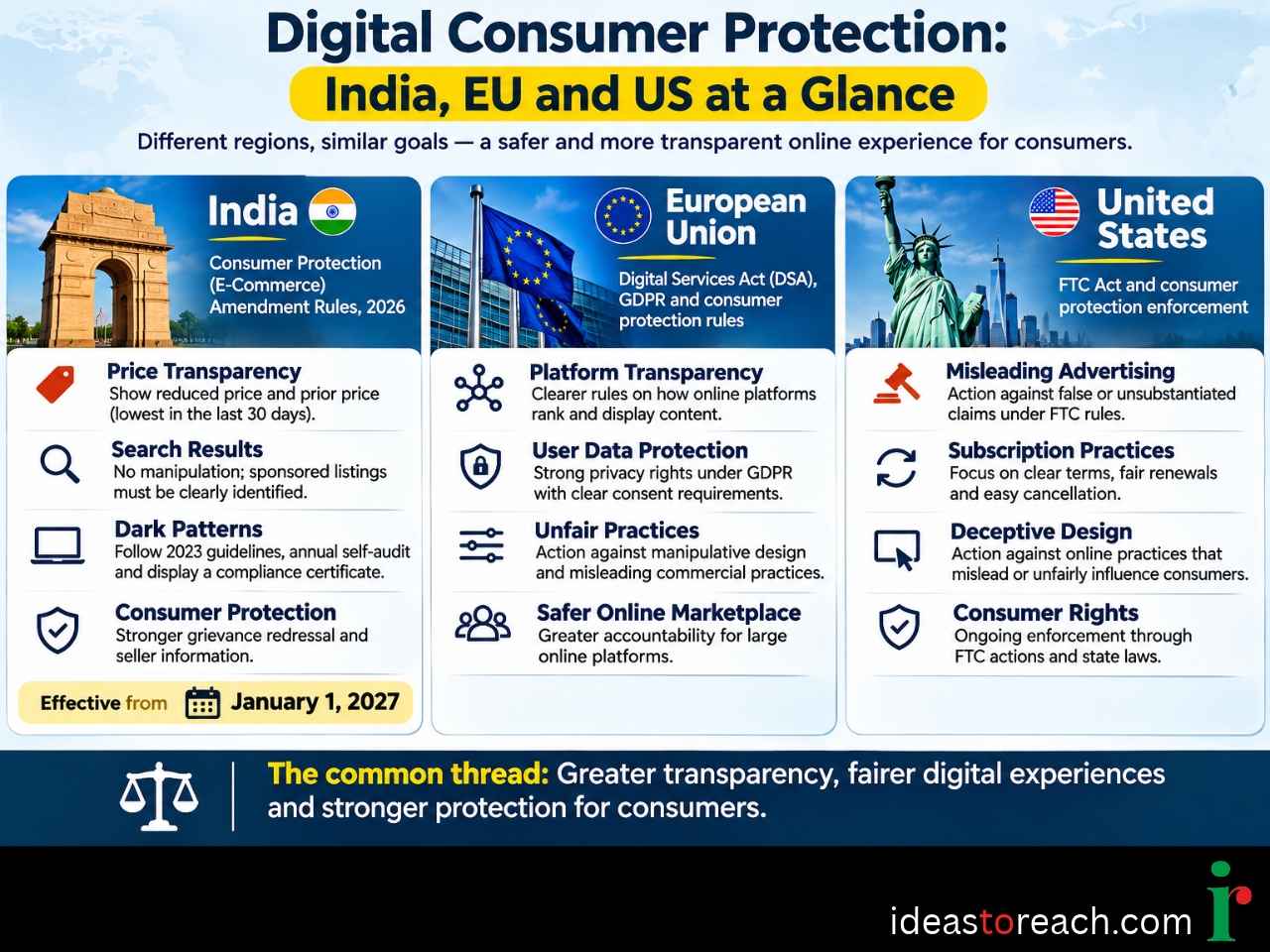
India is not alone in examining deceptive online design.
Regulators in several countries have been addressing dark patterns, misleading advertising, subscription practices and the transparency of digital platforms.
The approaches are not identical.
European Union
The European Union has developed a substantial regulatory framework addressing digital services, consumer protection and personal data.
The Digital Services Act includes requirements concerning online platform transparency and restrictions on certain manipulative interface practices.
The GDPR governs personal data processing and related rights.
Other EU consumer protection rules also address misleading commercial practices and price reduction announcements.
United States
In the United States, the Federal Trade Commission has long addressed deceptive and unfair commercial practices.
Its enforcement work includes misleading advertising, subscription practices and deceptive digital interfaces.
State laws and sector-specific regulations also play important roles.
India
India's approach combines the Consumer Protection Act, e-commerce rules, dark-pattern guidelines, advertising requirements and sector-specific regulation.
The 2026 amendments place additional emphasis on price transparency, sponsored listings, search-result integrity and platform accountability.
It would be inaccurate to claim that India is the only country taking such measures or that every jurisdiction applies identical rules.
But the direction is increasingly clear.
Digital convenience should not come at the cost of informed consumer choice.
For businesses serving international markets, this is particularly relevant.
An advertising practice accepted in one market may require modification in another.
Will These Rules Affect Small Businesses and Local Service Providers?
Consider a local business in Chennai.
It has a website, runs Google Ads and accepts enquiries through a contact form.
Does it automatically become subject to every new e-commerce requirement?
No.
The legal position depends on the nature of the business, how it sells goods or services and which laws apply to its activities.
A simple lead-generation website is not necessarily equivalent to an online marketplace.
However, smaller businesses should not assume that misleading advertising is acceptable merely because they do not operate a large e-commerce platform.
General consumer protection and advertising requirements may still apply.
A local service provider claiming to be the best in India should have an appropriate basis for that claim.
A business advertising a limited-period offer should ensure the offer is genuine.
A company displaying customer reviews should not fabricate them.
These principles apply regardless of whether the marketing budget is ₹10,000 or ₹10 crore.
What Should Businesses and Digital Marketing Agencies Review Before January 2027?
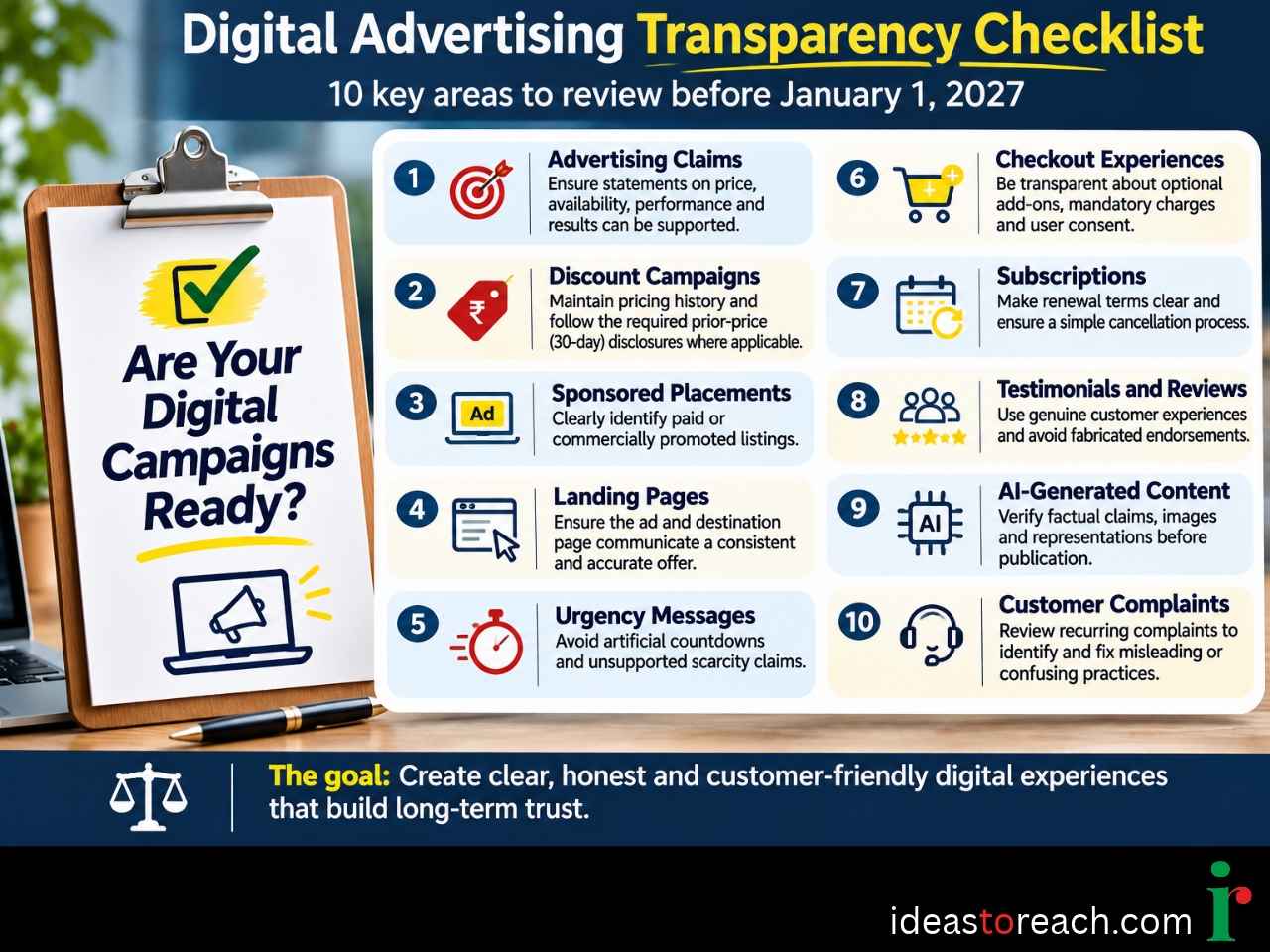
The new amendments provide an opportunity to examine digital marketing practices more carefully.
For businesses operating covered e-commerce platforms, compliance with the applicable provisions is a legal priority.
For other advertisers, the same exercise can improve communication and reduce misleading customer experiences.
Here are ten areas worth reviewing:
- Advertising claims: Check whether statements about price, availability, performance, ratings and results can be supported.
- Discount campaigns: Maintain accurate pricing histories and apply the required reference-price disclosures where applicable.
- Sponsored placements: Make commercial promotions clearly identifiable wherever disclosure is required.
- Landing pages: Ensure the advertisement and destination page communicate a consistent offer.
- Urgency messages: Remove artificial countdowns and unsupported scarcity claims.
- Checkout experiences: Examine optional additions, mandatory charges and consent mechanisms.
- Subscriptions: Make renewal conditions and cancellation processes clear and compliant.
- Testimonials and reviews: Use authentic customer experiences and avoid fabricated endorsements.
- AI-generated marketing content: Verify claims, images and representations before publication.
- Customer complaints: Identify recurring complaints that may reveal misleading advertising or confusing website design.
Businesses covered by the amended e-commerce rules must also address the specific compliance obligations, including annual dark-pattern self-audits and the required compliance certificate.
A wider website and online visibility audit can also help businesses examine how clearly their websites communicate information to visitors.
However, an SEO or website audit is not a substitute for a legal compliance review.
Will Consumers Actually Benefit?
That depends on implementation.
Rules can establish obligations.
But enforcement determines whether those obligations change behaviour.
Consumers also need to recognise misleading practices and know how to raise complaints.
Platforms must implement the requirements meaningfully rather than treating them as a formality.
And businesses must understand that compliance is not simply about changing a few words in their advertisements.
Consider a shopping platform that removes a misleading countdown but continues to hide important charges.
Or a business that labels sponsored results correctly but uses inaccurate testimonials.
The underlying problem has not disappeared.
Real improvement requires a more consistent approach to how offers are presented and how customer decisions are influenced.
What Should Consumers Look Out For?
Consumers have a role to play as well.
Before responding to an online offer, ask a few simple questions:
Is the discount genuine?
Does the advertised price include all relevant charges?
Is the recommendation sponsored?
Is the urgency real?
Can the claim be verified?
Are the subscription terms clear?
Is the business providing enough information to make a decision?
These questions are especially important for expensive or consequential purchases such as homes, medical treatment, educational programmes and financial products.
The aim is not to distrust every advertisement.
It is to recognise that an attractive offer deserves examination before becoming a commitment.
The Bigger Question: What Kind of Digital Marketing Do We Want?
Digital marketing has changed dramatically over the years.
Businesses once struggled to reach customers.
Today, they can reach highly specific audiences almost instantly.
A small business can compete for visibility with established brands.
A new product can reach thousands of potential buyers within hours.
A local service provider can attract customers from across the country.
These are genuine achievements.
But somewhere along the way, parts of the industry became excessively focused on immediate responses.
More clicks.
More leads.
More conversions.
More urgency.
More persuasive messages.
And sometimes, less attention to what happens after the customer clicks.
The new consumer protection measures provide a reason to reconsider that imbalance.
A click is not the same as trust.
An enquiry is not the same as a satisfied customer.
A conversion is not necessarily evidence that the customer made a well-informed decision.
Businesses need sales.
Agencies need results.
Advertising platforms need revenue.
None of these commercial objectives is inherently wrong.
But the interests of businesses and consumers should not be treated as opposing forces.
A business can be profitable while communicating honestly.
A marketer can be creative without manufacturing urgency.
An advertisement can be persuasive without concealing important information.
And a website can be designed to help visitors make decisions rather than push them into decisions.
Final Thoughts: A Wake-Up Call for Businesses and Digital Marketers
January 1, 2027, will not suddenly transform every shopping app or website in India.
Advertisements will continue.
Discounts will continue.
Sponsored listings will continue.
Businesses will still compete for attention.
And digital marketers will continue finding creative ways to reach potential customers.
What should change is the willingness to use misleading methods simply because they generate measurable results.
For years, many businesses have asked one question before approving an advertising campaign:
"Will this generate leads?"
Perhaps it is time to add another:
"Will customers still trust us after they discover the complete truth about our offer?"
That question deserves a place in every marketing discussion.
India's new e-commerce rules are an important regulatory development.
Their ultimate impact will depend on how businesses comply and how effectively the rules are enforced.
But the lesson for digital marketing extends beyond regulation.
The internet does not need fewer compelling advertisements.
It needs more advertisements that deserve the attention they receive.
And businesses that understand this distinction may discover something valuable.
A customer who trusts an advertisement is worth far more than a visitor who was merely persuaded to click.
Official References and Further Reading
The following official resources provide the regulatory background for this article:
- Government of India, Press Information Bureau: Government Amends E-Commerce Rules to Strengthen Consumer Protection and Promote Transparency, September 10, 2026.
- Department of Consumer Affairs: Consumer Protection Rules and Amendments, including the Consumer Protection (E-Commerce) (Amendment) Rules, 2026.
- Department of Consumer Affairs: Guidelines for Prevention and Regulation of Dark Patterns, 2023.
- Central Consumer Protection Authority: Consumer Protection and Advertising Guidelines.
Editorial note: This article discusses India's Consumer Protection (E-Commerce) (Amendment) Rules, 2026 and related consumer protection principles. The amendments apply according to their legal scope. Industry examples are illustrative and do not constitute findings of wrongdoing by any named business. The discussion is intended for general information and is not legal advice.